Contents
- Start with the work you want to review
- A task-based comparison of maths websites
- Test the exact activity before the lesson
- Worked activity: show why one half has different names
- Read the representation and explanation together
- Share, collect, review and respond
- Paper version when the website or device is unavailable
Start with the work you want to review
Choose a maths website by deciding what you want to inspect afterwards: a model, an explanation, or both. For a fraction-equivalence lesson, ask pupils to make equal amounts using different numbers of equal parts, then explain why the amounts are equal. Plan how you will collect that evidence before assigning the activity.
Use the shortlist below to choose between constructing fraction models and interpreting ready-made representations. The worked activity uses the Math Learning Center Fractions app; a paper version follows the same mathematical task.
A task-based comparison of maths websites
Fractions — The Math Learning Center
Mathematical purpose: represent, compare and perform operations with fractions.
Representations and controls: bar and circle models; denominators from 1 to 100; coloured parts; numeric labels that can be shown or hidden; and superimposed models for comparison.
Access: the official page offers a web app, an iOS version and a web-app installation option. It describes use on laptops, iPads and Chromebooks.
Choose this app when you want pupils to construct and adjust their own representations. For the lesson below, use bars so pupils can align equal-length wholes and compare the shaded lengths. Ask for an explanation alongside the model rather than accepting a finished picture alone.
Feedback and work review: the Fractions page describes visual comparison through superimposing models. The Math Learning Center’s Math Apps page also describes sharing app work through an eight-character code or link, including pupils sharing their thinking with teachers and classmates. Fractions — The Math Learning Center Math Apps — The Math Learning Center
Matching Fractions — NRICH
Mathematical purpose: match different representations of the same fraction.
Representations and controls: a card-matching interactivity, including a face-up version that removes the need to remember hidden card positions.
Feedback: matching cards stay face-up; non-matching cards turn back over in the standard game.
Access and review: the page provides printable cards, teacher prompts and a suggested approach beginning with pairs sorting cards face-up.
Choose NRICH when your question is, “Can pupils recognise the same fraction in different representations?” Use the face-up option and ask pupils to record one matched pair with a reason. Review their explanation, not just whether the game accepted the match.
PhET Fractions: Equality remains a candidate to test, rather than a recommended activity here. Its official listing was identified, but the available simulation page did not establish its representations, controls, feedback, account requirements, device support or work-capture options. Do not substitute it for the worked lesson without testing the exact simulation first.
The Math Learning Center and NRICH pages do not establish pupil account requirements. They also do not establish automatic collection of class submissions, assessment of written explanations or saved attempt histories. Treat model sharing and matching feedback as distinct from teacher assessment; arrange your own collection route.
Test the exact activity before the lesson
Run the exact activity as a pupil before assigning it. Use this checklist rather than testing only the website’s home page.
□ Open the precise activity on the device and browser pupils will use; check for sign-in, installation or other access barriers.
□ Try the controls needed for the lesson: create a whole, change its partitions, shade parts, move a model and reset or correct a mistake.
□ Check whether pupils can read the labels and distinguish shaded regions at the intended screen size.
□ Check that the models you will compare use equal-sized wholes and that pupils can align them clearly.
□ Try the activity with the actual device arrangements: individual, paired or shared-screen use.
□ Test how a pupil will preserve the representation and send or hand in its explanation.
□ Reopen one test submission from the teacher’s side. Can you see the whole, the partitions, the shaded amount and the explanation?
□ Ask someone to explain one choice without relying on the website’s response. Revise the prompt if it produces only “because it matched”.
Decide what evidence will change your next teaching step. Informal and formal assessment in primary mathematics offers a useful planning approach: begin with the question you need answered, then choose how to collect and use the evidence. Here, the question is whether the pupil can connect equal-sized wholes, equal parts and an unchanged shaded amount.
Worked activity: show why one half has different names
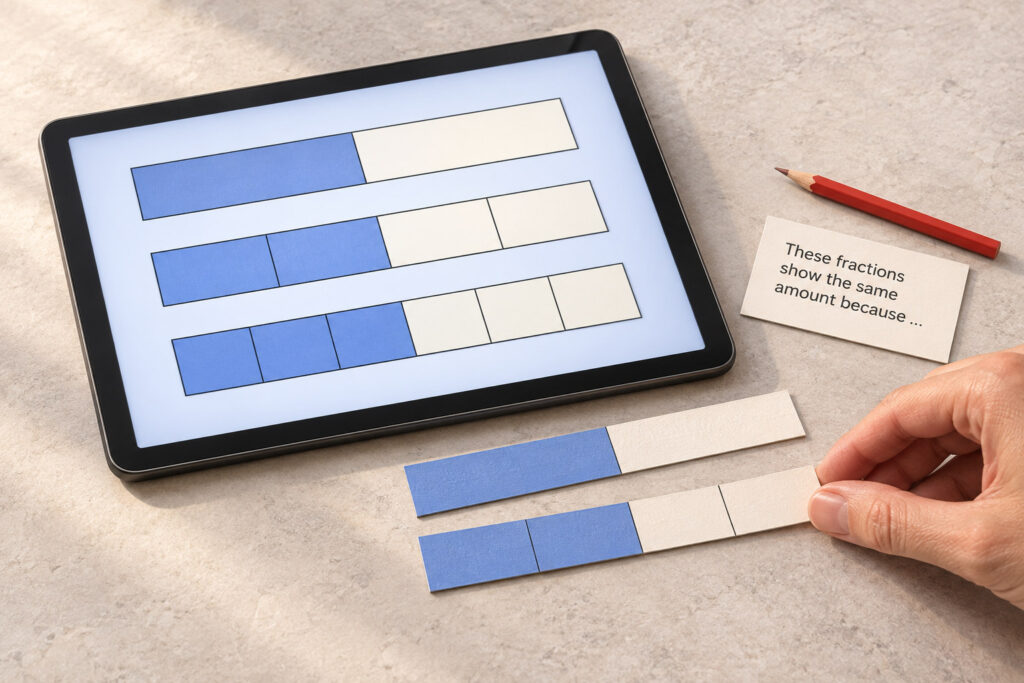
Prepare an opening model with one bar divided into two equal parts and one part shaded. Plan to collect one final representation showing 1/2, 2/4 and 3/6, plus a short explanation. Keep a separate comparison with 2/6 for a check that pupils are considering the amount, not merely noticing different fraction names.
The classroom examples and pupil responses below are hypothetical. Model the decisions, not just the clicks. Say: “This whole is divided into two equal parts. One part is shaded, so I am representing one half. I will make another whole the same size, divide it into four equal parts and shade two. I am checking the size of the whole before comparing the shaded amounts.” Align the bars or superimpose them. Ask pupils what stayed the same and what changed.
Pause before giving a rule. Ask: “What does the 4 count? What does the 2 count? Where can you see the same amount as one half?” Invite pupils to point to the model while explaining. Then ask them to investigate sixths rather than demonstrating that case immediately.
Representation-and-explanation task card
1. Make a bar showing 1/2.
2. Make an equal-sized whole showing 2/4. Position the bars so someone else can compare them.
3. Make another equal-sized whole divided into sixths. Shade an amount equal to 1/2.
4. Keep a view of all three models, or capture two clear comparisons if one view is too crowded.
5. Explain: “These fractions show the same amount because …” Refer to the wholes, the parts and the shaded amount.
6. Now compare 2/6 with 1/2 using equal-sized wholes. Are they equal? Show and explain your decision.
Hand in: your representation, your explanation and your answer to question 6.
Prompts to offer without completing the task
“What are you treating as one whole?”
“How could you check that the wholes are the same size?”
“What happens to the size of each part when you use more equal parts?”
“Which parts of your picture support your explanation?”
“Would your reason help someone who could not see the fraction labels?”
Explained answer guide
Questions 1–3: the bars should show 1/2, 2/4 and 3/6 with equal-sized wholes. Their shaded lengths should match.
Question 5: a suitable explanation connects the equal wholes with the unchanged shaded amount. For example: “Each half contains two quarters or three sixths, so shading one half, two quarters or three sixths covers the same amount.”
Question 6: 2/6 is not equal to 1/2. On equal-sized bars, one half reaches three sixths, while two sixths stops one sixth short. A pupil may also explain that 2/6 is one third.
Read the representation and explanation together
Response: the pupil submits aligned bars showing 1/2, 2/4 and 3/6 and writes, “They end at the same place.”
What the work shows: the submitted models represent matching shaded lengths with equal-sized wholes.
Still to check: whether the pupil can explain the relationship between the parts, rather than relying only on visual alignment.
Follow-up: “How many sixths fit inside one half? Show me where they are.”
Response: the pupil submits correct models and writes, “I counted one shaded part, then two, then three.”
What the work shows: the pupil has counted shaded parts in the three representations; that is a valid way to identify their numerators.
Still to check: how the pupil connects those counts to the total number of equal parts and to equivalence.
Follow-up: “One, two and three are different counts. Why do they represent the same amount here?”
Response: the pupil writes “1/2 = 2/4” but draws bars with visibly different whole lengths.
What the work shows: the pupil has stated a correct equivalence, but this drawing does not demonstrate it by comparing equal-sized wholes.
Still to check: whether the unequal whole lengths were accidental or reflect how the pupil is interpreting the task.
Follow-up: “Redraw or resize the wholes to match. Does the shaded amount still support your statement?”
Response: the pupil labels a model 2/6 and says, “It is half because I shaded two parts.”
What the work shows: the pupil is using the shaded-part count in the explanation without accounting for all six equal parts.
Still to check: whether they can identify half of a partitioned whole.
Follow-up: “Point to all six parts. Where would you divide the whole into two equal groups? How many sixths are in each group?”
Share, collect, review and respond
1. Share one starting point. Give pupils the exact activity destination and task card. If you plan to use an app code or link, test it first and demonstrate how to open it.
2. State the hand-in requirement. Ask for the model and explanation together, using a consistent task title and the pupil identifier normally used in your classroom.
3. Capture the work. Use the tested app-sharing route or a device screen capture placed in your chosen classroom collection space. If neither works, ask pupils to redraw the model and write or dictate the explanation on paper.
4. Check receipt. Open a sample while pupils can still correct missing or unreadable work.
5. Review against the same questions: Are the wholes equal-sized? Are parts equal within each whole? Does the shading match the labels? Does the explanation justify equivalence?
Choose the next teaching step from the work, not from completion alone. If the models are unclear, revisit constructing and labelling a whole. If the models are correct but the explanation is only “they look the same”, ask pupils to connect halves, quarters and sixths by grouping parts. If both are clear, offer a fresh comparison such as 2/3 and 4/6 and ask for a prediction before modelling.
Give feedback that names an observable feature and one next action: “Your equal-length bars make the shaded amounts easy to compare. Now explain how many sixths make one half.” Keep the original capture beside the revision so you can inspect what the pupil changed.
Paper version when the website or device is unavailable
Prepare identical rectangular paper strips, colouring tools and a sheet for recording. Provide partitioned strips or support pupils to mark equal parts accurately. Use separate equal-length strips divided into halves, quarters and sixths.
Use the same task card: shade one half, two quarters and the matching number of sixths. Align the strip ends to compare the amounts, then attach the strips to the recording sheet and add the explanation. On a separate sixths strip, shade two sixths and explain why it is not one half. Collect the sheet and use the same answer guide and follow-up questions as for the digital task.
For managing shared strips and colouring tools, adapt the collect, use and return cards in Classroom procedure examples: collecting, sharing and returning maths equipment. Use them to establish where spare pieces stay and how pupils keep their current model together while working.