Contents
- Teach one complete equipment routine
- Preparation checklist
- Model, rehearse and review: a teaching sequence
- Copy-ready pupil routine cards
- Worked classroom examples: when the routine meets a problem
- Quick rehearsal prompts and response guide
- Observation checklist: decide what to teach again
- Related resources
Teach one complete equipment routine
Teach the journey of the equipment, not just the instruction to “get some cubes”. Show pupils who collects, where materials go during the task, how to request a shared resource and what happens when it is time to return it.
Saskatchewan Math recommends clearly communicating expectations for using maths tools, including retrieving and returning them, and keeping manipulatives in an easily accessible location. Saskatchewan Math: Math Tools & Resources
The procedure below is an adaptable teaching plan, not a tested protocol for counters and cubes. Adjust the collection roles, storage arrangements and prompts to your pupils and classroom before teaching it.
Preparation checklist
Manitoba Education’s guidance for multilevel classrooms includes storage bins that give easy access to maths manipulatives and other resources. Manitoba Education: Classroom Organization—The Physical Classroom Environment
Before the lesson, check the following:
□ Choose the counters, cubes or other tools pupils may use for this task.
□ Give each type of equipment a clear storage place. Add a matching picture or label to the tub and shelf if useful.
□ Put equipment where the pupils collecting it can reach it; arrange adult help where needed.
□ Decide whether pupils collect a whole tub or a prepared tray. Avoid leaving this ambiguous.
□ If using fixed sets, record the expected contents on the container so pupils have something to check against.
□ Choose a separate checking place for incomplete sets and show pupils where it is.
□ Put a tray or mat at each working area, with an agreed place for unused shared pieces.
□ Choose a collector for each table and plan how that role will rotate between lessons.
□ Decide how collectors will approach the storage area without all arriving together.
□ Prepare a way to record unfinished work: paper for a sketch and a sentence explaining the model.
□ Choose one return cue and prepare the pupil cards below.
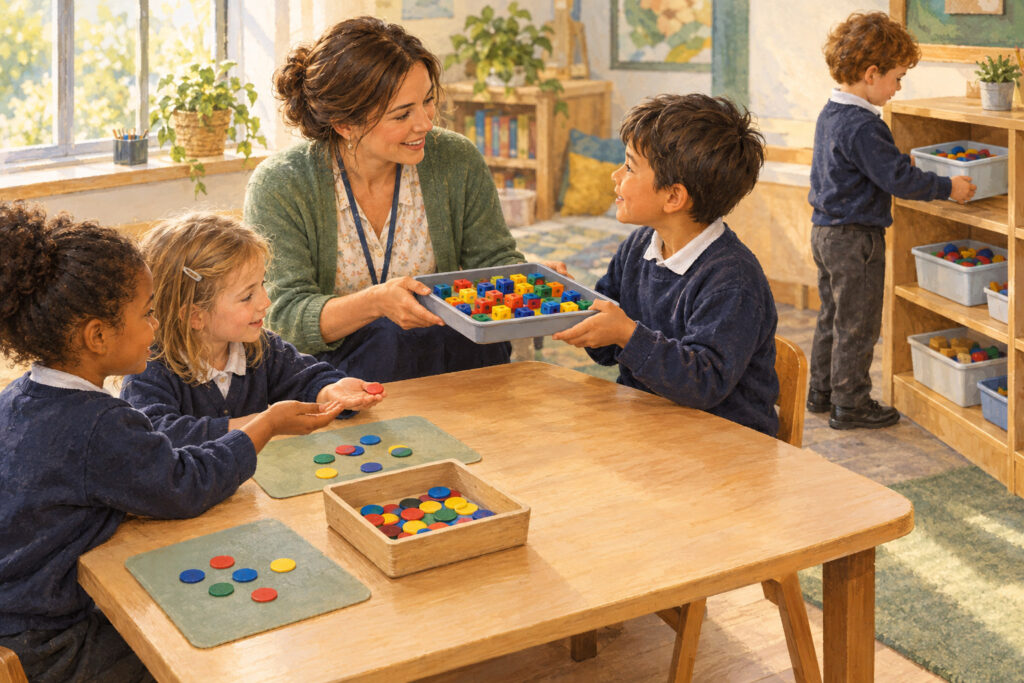
For this version, one collector takes and returns the table’s container. Everyone helps check its contents. Pupils may request a different tool during the lesson; the collector checks its availability rather than taking equipment from another group. Keep these roles the same in your demonstration, cards and reminders.
Model, rehearse and review: a teaching sequence
Department for Education / Teach First guidance recommends instructions that are specific, observable, sequential and manageable, with each step modelled as it is described. Department for Education / Teach First: How can you create an effective learning environment?—Theory
1. Explain the purpose and name the sequence.
Say: “We need to find our maths tools, use them together and leave them ready for the next person. Our routine is: collect, use, share, return.”
Point to the storage place, working area and routine cards. Ask pupils to identify where each part will happen.
2. Model collecting with a small group watching.
Say: “I am this table’s collector. I wait until our table is called. I check which equipment we need, take its container and bring it to our shared space.”
Carry out each action as you say it. Then ask: “Who collected? Where did the container go?” Have one pupil demonstrate the same short sequence before adding the next step.
3. Model using and sharing.
Put spare pieces in the agreed shared space and make a small model on a mat. Say: “These pieces are in my model. These spare pieces are available to our table.”
Ask a pupil to request a piece: “May I use a cube from the shared space?” Then model a request for something already in a model: “Are you still using this?” Reply: “Yes, it shows my thinking. You can use a spare piece, or we can ask for another tool.”
4. Model recording and returning.
Give an advance reminder: “We will return the equipment soon. If your model is unfinished, sketch it and write what you were working out.”
Demonstrate a quick sketch with a useful note. Then give the return cue: “Pause. Record anything you still need. Sort and check.”
Show everyone checking their working area, sorting equipment into its container and checking any fixed-set contents. Say: “If a piece is still missing after checking, tell me. The collector takes an incomplete set to our checking place, not back to its usual storage place.”
Demonstrate both destinations: return a complete container to its matching storage place, then show where an incomplete set goes.
5. Rehearse the whole journey.
Ask a small group to collect equipment, make a simple arrangement, request a shared piece and return everything. Let the class watch for one named step, such as whether the collector waits for the table to be called. Then let each table practise. If a step needs attention, pause there, demonstrate it again and let pupils retry that step before continuing.
6. Review with specific feedback.
Say what you observed: “You checked that the cubes were spare before taking them.” Ask: “Which step needed a reminder?” Choose one action to revisit next time rather than repeating every instruction.
Copy-ready pupil routine cards
Copy these cards after adapting them to the arrangements you have demonstrated. Read them together and point to the corresponding places and equipment.
COLLECT
1. Check which maths tools your table needs.
2. The collector waits until the table is called.
3. Take the agreed container from its storage place.
4. Put it in the table’s shared space.
If it is not available, tell your teacher.
USE
1. Take the pieces you need for your maths.
2. Keep your model on your working mat or tray.
3. Keep spare pieces in the shared space.
4. Tell your partner what your model shows.
SHARE
1. Ask before taking pieces from someone’s model.
2. Use spare pieces when they are available.
3. If a tool is already in use, ask about another option.
4. Do not take another group’s equipment without agreement.
RETURN
1. At the reminder, record unfinished work you still need.
2. At the return cue, sort pieces into the right containers.
3. Check your mat, table and nearby floor for pieces.
4. Check the container’s contents if it has a fixed set.
5. Tell your teacher if anything is missing.
6. The collector returns complete containers to their matching storage places. Take incomplete sets to the agreed checking place instead.
Worked classroom examples: when the routine meets a problem
The classroom examples and pupil responses below are hypothetical. Missing pieces: a fixed-set tray is short.
A pupil says: “Our tray should have twenty counters, but we have nineteen.”
Teacher: “Keep the counters together. Check your mat, table and the floor beside your place. If the counter is still missing, tell me; do not take one from another tray.”
Pupil: “We checked and it is still missing.”
Teacher: “Take the tray to our checking place so I can mark that it needs checking.”
Teaching point: demonstrate both the brief search and the reporting step, then show where the collector takes the incomplete set rather than returning it to normal storage.
Equipment already in use: the bead strings are with another group.
A collector says: “There are no bead strings left.”
Teacher: “Ask whether that group is still using theirs. If they are, come back and we will choose another available tool or agree a turn.”
Other pupil: “We are still using this one to show our answer.”
Collector: “I will ask about another tool.”
Teaching point: make the alternative depend on the mathematics. If a bead string is essential to this task, arrange a turn or change the task rather than insisting that any available tool will do.
Unfinished work: a pupil wants to keep a cube model.
Pupil: “Please do not put it away. I have not finished.”
Teacher: “Show me the part you need to remember. Sketch the rows and add a note about your next step.”
Pupil’s note: “Three rows of four cubes. Next I will find the total.”
Teacher: “Keep the sketch with your work. Now return the cubes with your table.”
If the pupil cannot record the model independently, help them make a quick sketch and capture their explanation before dismantling it. If you choose to keep a physical model instead, agree a separate place and check that the equipment can remain there.
Quick rehearsal prompts and response guide
Read these prompts aloud or copy them for a short rehearsal.
A. Your container is not on its shelf. What do you do?
B. You need a cube that is part of your partner’s model. What do you say?
C. The return reminder sounds, but your model is unfinished. What do you do first?
D. Your fixed-set tray is still short after you have checked your working area. What happens next?
Response guide
A. Tell the teacher the equipment is unavailable. Do not take another group’s container without agreement.
B. Ask, “Are you still using this?” Wait for the answer; use a spare piece or ask about another option if it is still needed.
C. Record the model and the next step, asking for help if needed. This keeps a record of the thinking before the pieces are returned.
D. Report the missing piece and put the tray in the teacher’s agreed checking place. Do not make one set complete by leaving another set short.
Observation checklist: decide what to teach again
Watch a small number of pupils or one table at a time. Against each step, record I for independent, P for prompted, or M for needs further modelling. Leave a step unmarked if you did not observe it; note the exact prompt or difficulty rather than judging the pupil’s character.
Date: __________ Table or pupils observed: __________
□ Identifies the equipment needed for the task. I / P / M
□ Collector waits for the agreed collection signal. I / P / M
□ Collects the agreed container and places it in the shared space. I / P / M
□ Keeps spare pieces available in the shared space. I / P / M
□ Asks before taking pieces from someone’s model. I / P / M
□ Uses the agreed response when equipment is unavailable. I / P / M
□ Records unfinished work, with agreed support where needed. I / P / M
□ Sorts equipment into the correct containers. I / P / M
□ Checks the working area and any fixed-set contents. I / P / M
□ Reports missing pieces. I / P / M
□ Collector returns complete containers to their matching storage places and takes incomplete sets to the checking place. I / P / M
Exact step to revisit: __________
Prompt, access support or change to storage needed: __________
Next opportunity to rehearse: __________
Use the notes to choose your next action. If pupils cannot locate a container, check the storage arrangement before reteaching collection. If several pupils take pieces from models, demonstrate the request-and-response exchange again. If only one step needs a prompt, rehearse that step rather than restarting the entire routine.
Department for Education / UCL guidance describes clarifying, modelling, practising and reinforcing routines, and notes that further modelling or practice may be needed when adherence decreases over time. Department for Education / UCL: Enabling pupil learning—Research and practice summary
Related resources
Teach Keyboarding With Shared Devices
Formative and summative assessment: plan both for one maths goal