Contents
Make both exchanges visible
Plan the lesson around one question: how can we rename 402 so that we can subtract 8 ones? Keep the drawing and the written calculation side by side, showing both exchanges before subtracting. Ask pupils to explain what changes in each column and what stays the same about the total.
For a calculation such as 402 − 178, the zero tens means there is no ten available to exchange for ones. First exchange one hundred for ten tens; then exchange one of those tens for ten ones. Oak National Academy describes this order of regrouping when the tens digit is zero. Review using column subtraction with regrouping from hundreds to tens — Oak National Academy
Prepare and check the starting knowledge
Prepare:
• A board or visualiser with three clearly separated columns: hundreds, tens and ones.
• Space for the original representation and two exchange drawings.
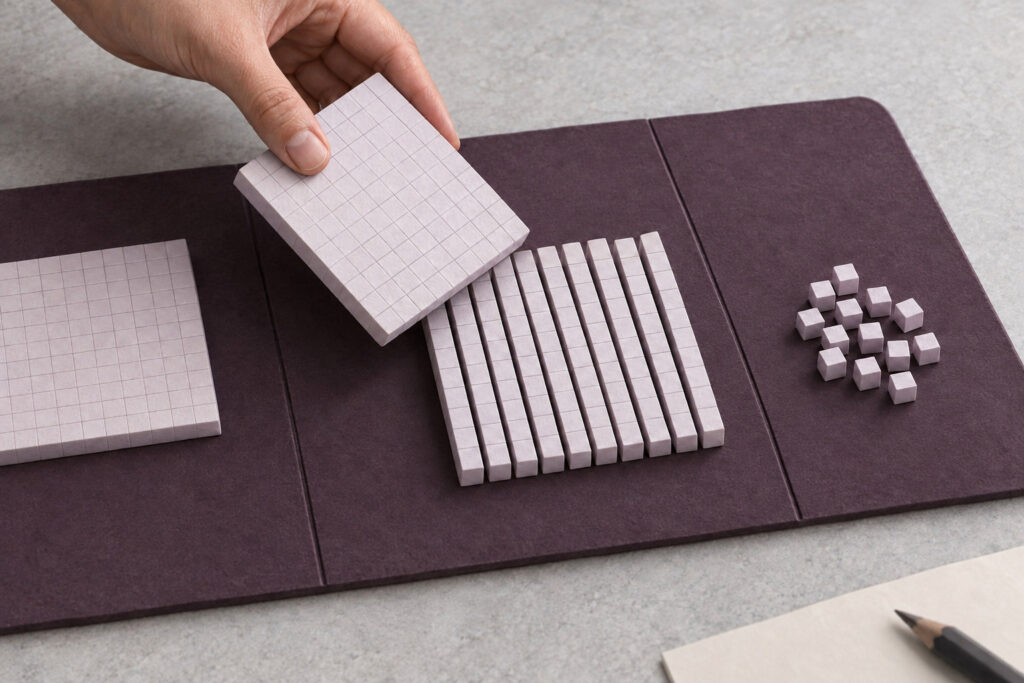
• Base-ten blocks, if you want to physically demonstrate the same exchanges.
• A copy of the recording frame below for each pupil.
• The partially completed example, practice questions and closing check, kept separate from their answers.
Use one drawing key throughout: □ represents one hundred, | represents one ten, and o represents one one. Keep each symbol inside its place-value column.
Before introducing the subtraction, ask pupils to draw or show:
1. One hundred, then the same value using only tens.
2. One ten, then the same value using only ones.
3. 402 as hundreds, tens and ones.
Ask: “How do you know the value has stayed the same after an exchange?”
The classroom examples and pupil responses below are hypothetical. Look for these responses:
1 hundred = 10 tens.
1 ten = 10 ones.
402 = 4 hundreds, 0 tens and 2 ones.
If a pupil cannot show either exchange, rehearse it with drawings or blocks before combining the exchanges in subtraction. If exchanges are secure but 402 is represented incorrectly, focus first on the zero as a placeholder in the tens column.
Model 402 − 178
Write 402 − 178 with hundreds under hundreds, tens under tens and ones under ones. Represent only the starting amount, 402; the drawing will show what is removed from it. Tell pupils: “I will rename the starting amount before I subtract. Watch how each exchange changes the groups, but not the total.”
Starting drawing:
Hundreds: □ □ □ □
Tens: none
Ones: o o
Say: “I have 4 hundreds, no tens and 2 ones. I need to subtract 8 ones, but only 2 ones are showing. There are no tens to exchange yet, so I must exchange a hundred first.”
After exchanging one hundred for ten tens:
Hundreds: □ □ □
Tens: | | | | | | | | | |
Ones: o o
Say: “One hundred has become ten tens. I now have 3 hundreds, 10 tens and 2 ones. That is still 402. I have not subtracted anything.”
Ask: “Which column lost a group? Which column gained groups?”
After exchanging one ten for ten ones:
Hundreds: □ □ □
Tens: | | | | | | | | |
Ones: o o o o o o o o o o o o
Say: “I exchange one of the ten tens for ten ones. There are now 9 tens, not 10. The 2 ones join the 10 new ones, making 12 ones. I now have 3 hundreds, 9 tens and 12 ones. That is still 402.”
Ask: “Where did the extra ones come from? Why must the tens count decrease?”
Record each stage with its units named. The start and both exchange lines describe the same amount, 402. The amount to subtract and the amount remaining have separate lines.
Start: 4 hundreds, 0 tens, 2 ones.
After exchanging one hundred: 3 hundreds, 10 tens, 2 ones.
After exchanging one ten: 3 hundreds, 9 tens, 12 ones.
Amount to subtract: 1 hundred, 7 tens, 8 ones.
Amount remaining: 2 hundreds, 2 tens, 4 ones.
Say: “Now I can subtract in each column: 12 ones minus 8 ones is 4 ones; 9 tens minus 7 tens is 2 tens; 3 hundreds minus 1 hundred is 2 hundreds. The difference is 224.”
On the final drawing, cross out 8 ones, 7 tens and 1 hundred. Leave 2 hundreds, 2 tens and 4 ones visible. Finish by checking 178 + 224 = 402. Ask pupils to point to the drawing that matches each stage of the exchange record.
A reusable exchange record
Copy this frame for further calculations. Ask pupils to complete both exchange lines before subtracting. On the Start and exchange lines, record unchanged values as well as changed ones: each of these lines must show the whole starting amount. Then record the amount being removed and the difference on their own lines.
Calculation: ______ − ______
Start: ______ hundreds, ______ tens, ______ ones.
After exchanging one hundred: ______ hundreds, ______ tens, ______ ones.
After exchanging one ten: ______ hundreds, ______ tens, ______ ones.
Amount to subtract: ______ hundreds, ______ tens, ______ ones.
Amount remaining: ______ hundreds, ______ tens, ______ ones.
After the first exchange, the total is still ______.
After the second exchange, the total is still ______.
I exchanged ______ because ____________________.
My answer is ______.
Addition check: ______ + ______ = ______.
Use both exchange lines for the across-zero tasks here. For a different calculation that does not need both exchanges, mark an unused line “not needed” rather than making an unnecessary exchange.
Move from a partial example to independent practice
The Department for Education’s early career teacher materials describe partially completed examples as worked examples with steps left blank to direct pupils’ attention to particular parts of the process. They also recommend independent practice after studying a worked example. Theory: Using worked and partially completed examples — Support for early career teachers
Complete 503 − 267.
Start: 5 hundreds, 0 tens, 3 ones.
After exchanging one hundred: 4 hundreds, 10 tens, 3 ones.
After exchanging one ten: 4 hundreds, ______ tens, ______ ones.
Amount to subtract: 2 hundreds, 6 tens, 7 ones.
Amount remaining: ______ hundreds, ______ tens, ______ ones.
Draw the representation after the second exchange.
Explain why the tens count is no longer 10.
Finish: 503 − 267 = ______.
Answer: after both exchanges, there are 4 hundreds, 9 tens and 13 ones. One of the 10 tens has been exchanged, leaving 9 tens; its 10 ones join the original 3 ones.
13 ones − 7 ones = 6 ones.
9 tens − 6 tens = 3 tens.
4 hundreds − 2 hundreds = 2 hundreds.
503 − 267 = 236.
Check: 267 + 236 = 503.
Then set these questions independently. Ask pupils to show the two exchanges using the frame and a place-value drawing, then check by addition.
A. 604 − 286
B. 701 − 458
C. 602 − 397
D. 405 − 68
A. 604 − 286
604 → 5 hundreds, 10 tens, 4 ones → 5 hundreds, 9 tens, 14 ones.
14 − 6 = 8 ones; 9 − 8 = 1 ten; 5 − 2 = 3 hundreds.
Answer: 318. Check: 286 + 318 = 604.
B. 701 − 458
701 → 6 hundreds, 10 tens, 1 one → 6 hundreds, 9 tens, 11 ones.
11 − 8 = 3 ones; 9 − 5 = 4 tens; 6 − 4 = 2 hundreds.
Answer: 243. Check: 458 + 243 = 701.
C. 602 − 397
602 → 5 hundreds, 10 tens, 2 ones → 5 hundreds, 9 tens, 12 ones.
12 − 7 = 5 ones; 9 − 9 = 0 tens; 5 − 3 = 2 hundreds.
Answer: 205. Record the zero tens between the hundreds and ones.
Check: 397 + 205 = 602.
D. 405 − 68
Place 6 in the tens column and 8 in the ones column; there are no hundreds to subtract.
405 → 3 hundreds, 10 tens, 5 ones → 3 hundreds, 9 tens, 15 ones.
15 − 8 = 7 ones; 9 − 6 = 3 tens; 3 − 0 = 3 hundreds.
Answer: 337. Check: 68 + 337 = 405.
Respond to what pupils actually show
Pupil response: “I changed 4 hundreds to 3 hundreds and put 10 in the ones column.”
Follow-up: “What is one hundred worth in tens? Draw that exchange first. Which unit can we exchange directly for ten ones?” Ask the pupil to show the intermediate stage: 3 hundreds, 10 tens, 2 ones.
Pupil response: “Now I have 3 hundreds, 10 tens and 12 ones.”
Follow-up: “Point to the ten you exchanged. Is it still available in the tens column?” Ask the pupil to remove that rod and recount the remaining tens. Then have them check whether the recorded groups still total 402.
Pupil response: “I have 4 hundreds, 9 tens and 12 ones.”
Follow-up: “Where did the ten tens come from? Show which hundred was exchanged.” Ask the pupil to update the hundreds count before continuing.
Oak National Academy’s guidance on column calculations states that digits with the same place value should be aligned. Solving problems using column addition and subtraction — Oak National Academy
Pupil response: for 405 − 68, the pupil puts 6 beneath 4 and 8 beneath 0.
Follow-up: “What is the value of the 6 in 68? Which column holds tens? Where should the 8 ones go?” Have the pupil rewrite the calculation under hundreds, tens and ones headings before exchanging.
Pupil response: “I counted up from 178 to 402 and got 224.”
Follow-up: “Show how you checked your total. Now connect your answer to our exchange drawing: where can you see the 2 hundreds, 2 tens and 4 ones left?” Accept a correct counting strategy while still asking for the place-value representation that is the focus of this lesson.
Close with a check that informs the next lesson
Set a short closing check:
302 − 157
1. Show the starting amount.
2. Record both exchanges.
3. Find the difference.
4. Explain why the tens count becomes 9.
Answer guide: 302 becomes 2 hundreds, 10 tens and 2 ones, then 2 hundreds, 9 tens and 12 ones. Subtracting gives 1 hundred, 4 tens and 5 ones: 145. The tens count becomes 9 because one of the 10 tens is exchanged for 10 ones. Check: 157 + 145 = 302.
Choose the next step from the response:
• Exchanges and subtraction are correct, with an explanation: offer another across-zero calculation and ask the pupil to explain it without the full frame.
• Exchanges are correct but subtraction is inaccurate: retain the exchange record and practise the particular subtraction fact involved.
• A hundred or ten remains after being exchanged: return to physically removing the exchanged unit and replacing it with equal-value smaller units.
• Digits are misaligned: use labelled columns and ask for each digit’s value before calculating.
• The answer is correct but the exchange record is absent: ask the pupil to reconstruct the two exchanges before deciding whether to remove that support.
If colleagues will use the same closing check, use Common formative assessments: a primary mathematics planning kit to agree the focus, what different responses would show and the next teaching step. For this lesson, record exchange understanding, alignment and subtraction accuracy separately rather than reducing the work to one right-or-wrong score.