Contents
- Make the request about the sticking point
- 1. Prepare and introduce the routine
- 2. Model clarification and mathematical help
- 3. Rehearse with specific maths situations
- 4. Manage waiting and teacher check-ins
- Ready-to-copy help-request cards
- A short waiting-task practice strip
- Track requests and review what to teach next
Make the request about the sticking point
Teach one short routine: show the sticking point, signal for help, then use an agreed waiting task. Keep the pupil’s unfinished maths visible so that your check-in can begin with what they understand and where they need support—not with starting the whole task again.
The Education Endowment Foundation’s guidance on metacognition and self-regulated learning says these strategies appear to be more effective when embedded in a specific subject lesson. Introduce the routine through the maths pupils are currently learning, rather than only discussing help requests in the abstract. Metacognition and Self-Regulated Learning
This is an adaptable teaching routine, not an evaluated programme with demonstrated outcomes. Use the cards and observation sheet to decide what needs further modelling in your classroom.
1. Prepare and introduce the routine
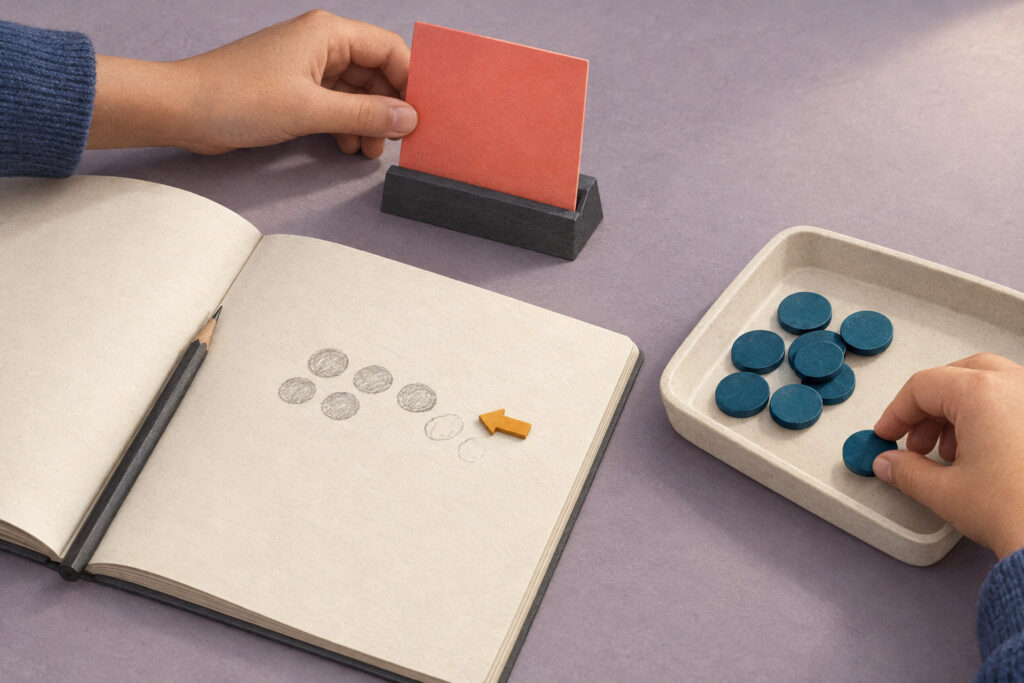
Before the lesson, choose one visible help signal, such as standing a card in a desk holder. Decide how you will acknowledge it, where pupils can find a familiar worked example, and which already-taught activity they can do while waiting. Put these arrangements on display and demonstrate them with the actual materials.
Display this pupil sequence:
1. Show where you are stuck: point, circle, draw or tell.
2. Ask: “Please help me with…” Use the class help signal.
3. Leave that work visible and use the agreed waiting task.
4. When the teacher comes, show the sticking point and try the next step together.
Do not make a completed written request, a fixed number of attempts or finishing a waiting task a condition of receiving help.
The classroom examples and pupil responses below are hypothetical. Introduce it with: “You can ask for help when you need it. You do not have to know the name of the difficulty. Show me the part you want help with—even if that is the first instruction. While I am helping someone else, keep your work open and use our waiting task.”
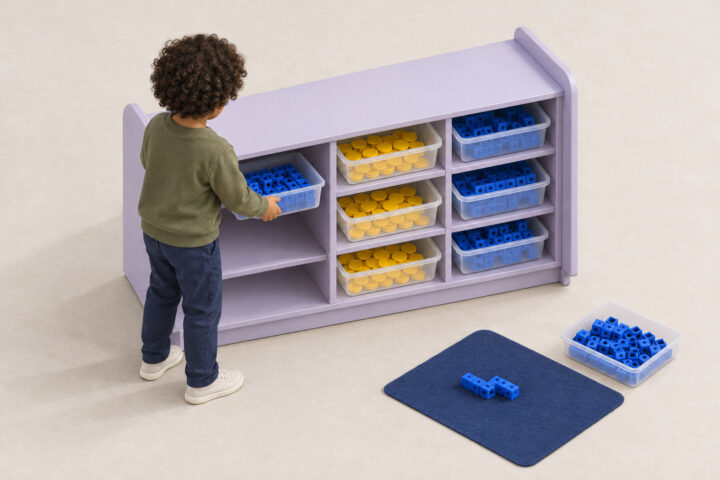
If the waiting task uses counters or other shared apparatus, teach access to those materials too. Classroom procedure examples: collecting, sharing and returning maths equipment includes steps for requesting pieces, responding when equipment is unavailable and recording a model before returning it. Use those steps where equipment access would otherwise interrupt this routine.
2. Model clarification and mathematical help
Model the routine using a task pupils recognise. Think aloud briefly, mark the precise stopping place, raise the signal and begin the waiting task. Then model your return as the teacher. Show the whole sequence, including how the pupil resumes the original maths after support.
Use two practical opening questions at a check-in:
“Are you unsure what the task is asking you to do?”
“Or do you know what to do, but need help with the maths?”
Then add: “It can be both. Show me.”
Treat these as starting questions, not formal diagnostic categories. A pupil may need the instruction clarified and then need mathematical support.
Clarification script
Task: “Use a drawing to show 24 shared equally between 4 groups.”
Pupil: “Do I write a number or draw something?”
Teacher: “The instruction asks for a drawing of equal groups. You can write the answer beside it too. Show me how you would begin your drawing.”
Possible next step: If the pupil starts representing equal groups, leave them to continue and return to check. If they ask what equal groups means, move into mathematical help rather than repeating the instruction.
Mathematical-help script
Pupil: “I know I need equal groups, but I don’t know how to share 24.”
Teacher: “Show me the groups you have started. What could you do with the counters next?”
Pupil: “Put one in each group and keep going.”
Teacher: “Try that. How will you check that the groups are equal?”
Possible next step: Observe the distribution. If the pupil still cannot begin, model one round of sharing, then invite them to continue. Finish by connecting the model to 24 ÷ 4 = 6.
The EEF describes visual, verbal and written scaffolds and highlights giving the least amount of support first. For this routine, begin with an invitation to show the work, then add a prompt or model if the pupil needs it. What goes up, must come down: Promoting pupil independence through scaffolding
3. Rehearse with specific maths situations
Rehearse before asking pupils to use the routine independently. In pairs, give one pupil a short maths task and a sticking-point scenario; the partner practises acknowledging the request and asking to see the work. Swap roles. Rehearse the signal and waiting task as carefully as the words of the request.
Rehearsal scenario: a calculation strategy
Task: 36 + 27
Pupil: “I split it into 30 + 20 and 6 + 7. I got 50 and 13, but I’m stuck here.”
Teacher: “You have found both parts. Show 50 and 13 with a drawing or equipment. How could you combine them?”
Possible next step: Ask the pupil to connect 50 + 10 + 3 to 63. If combining the parts remains difficult, model that step and offer 34 + 28 as a follow-up.
Rehearsal scenario: a strategy that works
Task: 8 + 5
Pupil: “I counted on: 9, 10, 11, 12, 13. Do I have to make ten?”
Teacher: “Your counting-on method gives 13. Let’s check today’s instruction: are we choosing a method or practising making ten?”
Possible next step: If the task permits a choice, accept the valid method. If the task is specifically about making ten, show how 5 can be split into 2 and 3, so 8 + 2 + 3 = 13. Do not treat counting on as a misconception.
After rehearsal, ask: “Could I see the sticking point? Was the help signal clear? Did the waiting task make sense?” Re-model the missing step rather than asking pupils simply to “be more independent”.
4. Manage waiting and teacher check-ins
Use this short acknowledgement: “I have seen your request. Keep that part open. Use your waiting task; I will come back.” Make a brief note if you cannot respond immediately. When you return, ask, “Show me where you stopped,” rather than requiring the pupil to recite the whole card.
Choose waiting tasks that pupils can access using already-taught maths. Do not send them into another version of the same difficulty. Offer a familiar alternative if they cannot use the first choice, and check back rather than letting the waiting activity replace the help they requested.
Copyable waiting-task prompts
Keep my original work open. Choose the task my teacher has agreed:
• Look at our familiar worked example. Point to the step that matches my work, or mark where it stops helping.
• Draw or build the part I understand. Leave a space or question mark at the part I need help with.
• Do the familiar practice strip my teacher has selected.
• If none of these is accessible, show my teacher that I need another waiting task.
When help arrives, pause this activity and return to my original question.
The EEF’s maths problem-solving guidance describes worked examples as step-by-step models used after initial teaching to scaffold practice. Keep any waiting-task example connected to a method you have already taught, rather than using it to introduce unfamiliar content without support. How can we improve children’s problem solving in maths?
Check pupils who have not signalled as well as those who have. Ask, “Show me what you are working on. What is your next step?” Keep track of unanswered requests, but use what you see to decide whether a pupil needs an immediate check-in or whether several pupils need a brief shared explanation.
Ready-to-copy help-request cards
Full help-request card
My question or page: __________
I am stuck here: __________
I can show this by pointing, drawing, speaking or writing.
What I understand or have done so far: __________
I need help with the instruction / the maths / both / I’m not sure.
My request: “Please help me with __________.”
I have shown my help signal.
While I wait, my agreed task is: __________
Short help-request card
SHOW: Here is the part.
ASK: Please help me.
WAIT: Keep my work open and use my agreed task.
Use this version when the full card adds too much writing or too many choices. Accept a point to the page and the help signal as a request; use the remaining prompts during your check-in.
CAST’s guidance on communication encourages multiple media for expression, including speech, drawing and physical manipulatives. A help request need not depend on writing when writing is not the learning goal. Use multiple media for communication
Prepare alternatives alongside the cards: a movable arrow to place beside a sticking point; a blank space for a sketch; or a brief spoken request while you note the location. Model each option. If a pupil points without explaining, say, “You are showing me this step. Are you unsure what to do here?” Let them confirm, reject or demonstrate instead of demanding a longer sentence.
Reduce prompts only when your observations suggest they are no longer needed. For example, replace the full frame with the short card while keeping pointing or speaking available. Do not remove a pupil’s communication option as a test of independence.
A short waiting-task practice strip
Use this practice strip only if these additions are already familiar and accessible. Otherwise substitute questions from previously taught work. Keep the answer guide available for checking after an attempt.
Waiting practice strip
A. 7 + 3 = ___
B. 7 + 5 = ___
C. 16 + 4 = ___
D. 16 + 7 = ___
Choose one answer to check with counters, a drawing or a second calculation.
Matching answer guide
A. 10: adding 3 to 7 completes ten.
B. 12: split 5 into 3 and 2; 7 + 3 = 10, then add 2.
C. 20: adding 4 to 16 completes twenty.
D. 23: split 7 into 4 and 3; 16 + 4 = 20, then add 3.
These explanations show one possible approach. Accept another valid calculation, drawing or counting strategy.
Track requests and review what to teach next
Copy this entry for each check-in you want to record. Use it as a planning note, not a validated score or a target for reducing requests. Include some check-ins that you initiate with pupils who have not signalled.
Teacher request-tracking sheet
Date and maths task: __________
Pupil: __________
Check-in: pupil requested / teacher initiated
Question or sticking point: __________
Need identified: instruction / maths / both / not yet clear
Request communicated by: pointing / drawing / speaking / writing / other
Support given—record the actual prompt or model: __________
What the pupil did next: __________
Waiting task accessible? What needs changing? __________
Follow-up question or task: __________
Follow-up completed and observed response: __________
At the end of the lesson, review a few entries. If requests cluster around task wording, revise that wording and model how to begin. If they cluster around a mathematical step, plan further explanation and practice of that step. If a pupil does not request help but cannot show a next step, rehearse their signal and communication option privately.
Close with a pupil review: “Could you show where you were stuck? Did you get the help you needed? Could you use the waiting task?” Use the answers and your observations to adjust one part of the routine for the next lesson. Look for usable requests, accessible waiting tasks and a return to the maths—not simply fewer hands raised.