Contents
Start with the teaching decision
Use this short check to decide whether to revisit digit value, zero as a placeholder, standard partitioning or alternative regrouping. Collect each pupil’s answer, ask for an explanation where needed, choose one focused follow-up task and then use the matching recheck question.
These are connected curriculum ideas. England’s Department for Education guidance includes recognising digit value, beginning to understand zero as a placeholder and partitioning numbers in different ways. Australian Curriculum Version 9 also includes standard and non-standard groupings of two- and three-digit numbers and the role of zero in place-value notation. Department for Education — National curriculum in England: mathematics programmes of study Australian Curriculum Version 9 — Mathematics, Year 2: WS02 — Trick or treat
Use the questions as classroom prompts, not a validated diagnostic test. Do not apply an attainment cut-off or infer a pupil’s understanding from a total score; use the particular response and explanation to choose the next task.
How to run the check
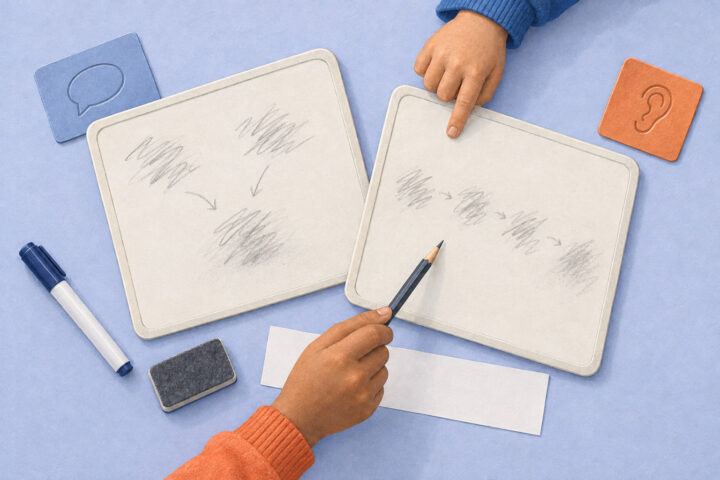
Prepare mini whiteboards or paper, a hundreds–tens–ones chart and materials for follow-up work. Use bundled sticks, base-ten drawings or counters whose column determines their value. Keep the initial response separate from anything pupils produce after a hint or demonstration.
Select questions to match pupils’ prior teaching rather than automatically using all five. Questions 1 and 4 use two-digit numbers; Questions 2 and 3 include hundreds; Question 5 asks for a hundreds-to-tens exchange. Use only the relevant subset to check previously taught content. If you deliberately include untaught content, record that item as a readiness check, not as evidence that corrective teaching is needed. Keep the same selection when choosing the matching rechecks.
Ask everyone to answer before inviting explanations. Show one selected question at a time, allow thinking time and collect responses together. Note pupils whose reasoning needs a closer look rather than stopping to resolve every response immediately.
The NSW Department of Education recommends response systems that check all pupils, not just volunteers. The Education Endowment Foundation describes multiple-choice hinge questions as an immediate check of initial understanding, with discussion following the choices. NSW Department of Education — Checking for understanding Education Endowment Foundation — Five ways to use diagnostic assessment in the mathematics classroom
Accept an explanation through speech, pointing, objects or drawings. If writing or interpreting the prompt seems to be getting in the way, ask the pupil to show the same idea in another form before choosing instruction. Australian Curriculum formative-assessment guidance advises checking learning another way when needed to confirm what a pupil knows, understands and can do. Australian Curriculum Version 9 — Embedding formative assessment
Copyable pupil question set
The classroom examples and pupil responses below are hypothetical. 1. Digit value
Look at 46.
What is the value of the digit 4?
Show or explain how you know.
2. Zero as a placeholder
A number has 3 hundreds, no tens and 5 ones.
Which numeral represents it: 35, 305 or 350?
What does the zero tell you in the numeral you chose?
3. Standard partitioning
Complete:
462 = ___ + ___ + ___
Write the value represented by each digit.
4. Alternative regroupings
Which descriptions have a total value of 46? Choose all that work.
A. 4 tens and 6 ones
B. 3 tens and 16 ones
C. 2 tens and 26 ones
D. 3 tens and 6 ones
Show why one of your choices works.
5. Regrouping across hundreds and tens
Complete:
305 = 2 hundreds + ___ tens + 5 ones
Draw or describe the exchange that makes this true.
Worked answer guide and explanation prompts
1. The 4 has a value of 40: four tens.
Representation: draw four tens rods and six ones; point to the four rods as the part represented by the digit 4.
Ask: “Where can you see the value of the 4 in your drawing?”
Accept “four tens” as an explanation of value; do not require the word “forty” as well.
2. The numeral is 305.
Representation: put three hundreds counters in the hundreds column, none in the tens column and five ones counters in the ones column.
The zero records no tens in this standard hundreds–tens–ones representation. By contrast, 35 represents three tens and five ones; 350 represents three hundreds and five tens.
Ask: “What would change if you removed the zero from 305?”
3. 462 = 400 + 60 + 2.
Representation: four hundreds, six tens and two ones.
Ask: “Which part of your sum matches each digit?”
If a pupil writes another correct partition, such as 300 + 160 + 2, acknowledge that it totals 462, then ask for the value of each written digit to check standard partitioning separately.
4. A, B and C all represent 46.
A: 40 + 6 = 46.
B: 30 + 16 = 46. Exchange one of the original four tens for ten ones.
C: 20 + 26 = 46. Exchange two of the original four tens for twenty ones.
D represents 30 + 6 = 36, not 46.
Ask: “What changed in the groups, and what stayed the same about their total value?”
5. The missing number is 10.
305 = 300 + 5 = 200 + 100 + 5 = 200 + 10 tens + 5.
Representation: begin with three hundreds and five ones. Exchange one hundred for ten tens, leaving two hundreds, ten tens and five ones.
Ask: “How can the original numeral have a zero in the tens place, but this regrouping have ten tens?”
Interpret responses before choosing instruction
Response: “The 4 is worth 4.”
Possible interpretation: the pupil may be naming the digit rather than giving its value, or may be treating it as four ones.
Clarify first: “Show me the part of 46 that the 4 represents.”
Next step: if the pupil shows four tens, record that understanding. If they show four ones, use the digit-value task below.
Response: chooses 35 for three hundreds, no tens and five ones.
Possible interpretation: the pupil may omit an empty place when writing the numeral, or may have misread “hundreds”.
Clarify first: “Put the groups on this chart. Now write a numeral to match.”
Next step: if the quantities are placed correctly but the written zero is omitted, focus on connecting the empty tens column to the written numeral.
Response: 462 = 4 + 6 + 2.
Possible interpretation: the pupil may be listing digit names rather than values, or may not have understood the requested sum.
Clarify first: “Does 4 + 6 + 2 have the same total as 462? Show what each digit represents.”
Next step: use standard-partitioning work if the pupil cannot connect the digits to four hundreds, six tens and two ones.
Response: chooses only A for Question 4 and says, “46 has four tens.”
Possible interpretation: the pupil recognises the standard grouping but has not yet shown whether they accept equivalent regroupings.
Clarify first: “Start with four tens and six ones. Exchange one ten for ones. What is the total now?”
Next step: use the tens-to-ones exchange task if the pupil thinks the exchange changes the total.
Response: chooses B, then counts all the represented ones to check 46.
Possible interpretation: the pupil has used a valid counting strategy and selected a correct regrouping. This is not itself a misconception.
Clarify first: “Can you also show why 3 tens and 16 ones match 4 tens and 6 ones without starting the count again?”
Next step: acknowledge the correct total; use an exchange demonstration if you need further evidence of regrouping reasoning.
Response: writes 0 in the blank in Question 5 and says, “305 has no tens.”
Possible interpretation: the pupil may be applying the standard representation to a question about an alternative grouping.
Clarify first: “The question leaves only two hundreds. What could replace the other hundred?”
Next step: use the hundreds-to-tens exchange task, then ask the pupil to explain both representations of 305.
Choose one targeted follow-up task
Digit value: build and point
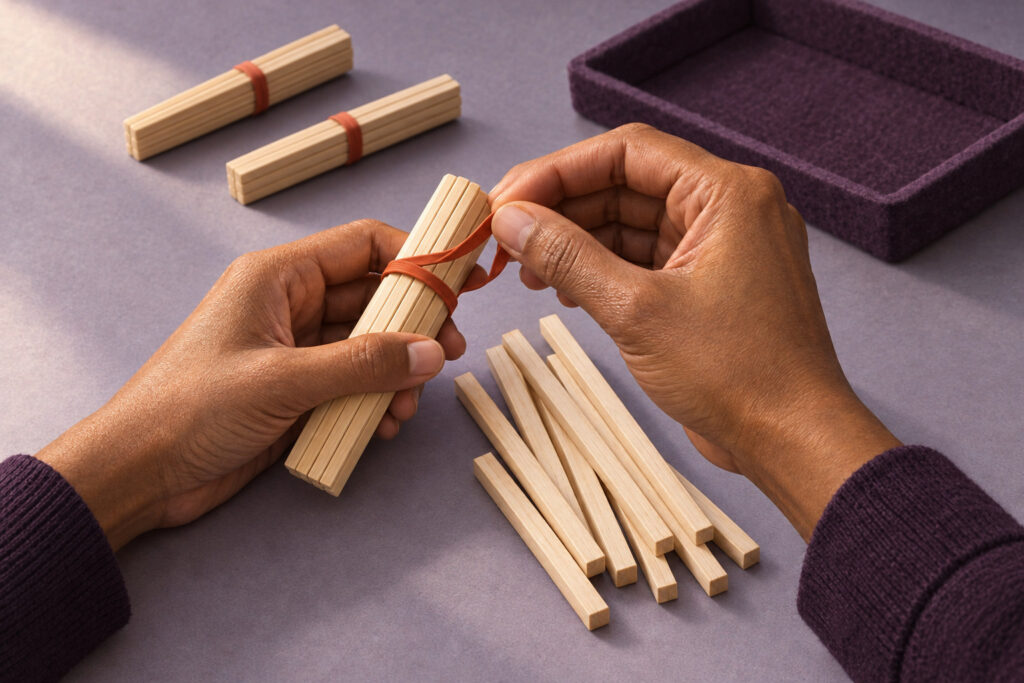
Build 46 with four tens bundles and six loose sticks. Ask the pupil to point to everything represented by the digit 4, then by the digit 6. Write 40 and 6 beneath the corresponding groups. Repeat with 64 and ask what has changed about the value of the digit 4. Move to recheck Question 1.
Zero placeholder: connect an empty column to notation
Use a hundreds–tens–ones chart to represent 305. Ask the pupil to write a digit for each column, including the empty tens column. Contrast it with 350 and 35 by drawing each representation. Ask: “Which column has no counters in each number, and how is that shown in writing?” Move to recheck Question 2.
Standard partitioning: connect each digit to a quantity
Represent 462 with a place-value drawing. Under each group, write its value: 400, 60 and 2. Ask the pupil to connect each written digit to its group and then write the sum. Cover the drawing and ask them to explain the three parts. Move to recheck Question 3.
Tens-to-ones regrouping: exchange, then record
Build 46 as four tens and six ones. Exchange one ten for ten ones. Ask the pupil to record both groupings and explain why the total has not changed. Exchange another ten and record again. Finally, ask them to reverse an exchange. Move to recheck Question 4.
Hundreds-to-tens regrouping: preserve value during an exchange
Represent 305 with three hundreds and five ones. Replace one hundred with ten tens. With place-value counters, remove one hundreds counter and add ten tens counters; do not simply slide one counter into the tens column. Ask the pupil to record the before-and-after groupings and explain what was exchanged. Move to recheck Question 5.
If the pupil explains all five answers securely, ask for several equivalent representations of 305 and an explanation of how to reverse each exchange. Keep the focus on explaining equivalence rather than simply increasing the size of the numbers.
Parallel recheck questions and answers
Use the recheck matching the selected initial question and teaching focus; you do not need to administer the whole set. For an item originally used as a readiness check, teach the new content before using its parallel question to check that teaching. Begin without the previous worked example in view. If the pupil needs a chart, objects or a prompt, record that support alongside the response.
1. What is the value of the digit 5 in 57? Show or explain.
2. A number has 4 hundreds, no tens and 7 ones. Choose 47, 407 or 470. Explain the zero in your choice.
3. Complete the standard partition:
573 = ___ + ___ + ___
4. Choose all descriptions with a total value of 57:
A. 5 tens and 7 ones
B. 4 tens and 17 ones
C. 3 tens and 27 ones
D. 4 tens and 7 ones
Explain one alternative regrouping.
5. Complete and explain the exchange:
407 = 3 hundreds + ___ tens + 7 ones
Recheck answers
1. 50: five tens.
2. 407: four hundreds, no tens and seven ones in the standard representation.
3. 500 + 70 + 3: five hundreds, seven tens and three ones.
4. A, B and C. Their values are 50 + 7, 40 + 17 and 30 + 27; each totals 57. D totals 47.
5. 10 tens. Exchange one of the four hundreds for ten tens: 400 + 7 = 300 + 100 + 7 = 300 + 10 tens + 7.
Compare the explanation as well as the answer. If the pupil now explains the relevant place-value relationship, choose further practice without the demonstration. If they reproduce an answer but cannot explain it, revisit the representation. If the evidence remains unclear, change the response format before deciding on more teaching.
Copyable teacher recording sheet
Pupil: ____________________ Date: ____________________
Focus: digit value / zero placeholder / standard partitioning / regrouping
Initial question number: ____________________
Purpose: check previously taught content / readiness check of untaught content
Exact answer, drawing or words: ____________________
Clarifying question asked: ____________________
What the pupil then showed: ____________________
Current interpretation: ____________________
Evidence status: shown / not yet shown / unclear
Chosen follow-up task or new teaching: ____________________
Representation or support used: ____________________
Matching recheck question number: ____________________
Recheck answer and explanation: ____________________
Recheck conditions: independent / supported — specify: ____________________
Next teaching step: ____________________
Record each focus separately. For example, a pupil might show digit value and standard partitioning while still needing work on equivalent regroupings. Keep the original response beside the recheck so that your next decision is tied to what the pupil actually demonstrated.
For shared planning with colleagues, use Common formative assessments: a primary mathematics planning kit to agree separate criteria for digit value, representation and equivalent partitioning, and to agree which prompts count as support. Use those distinctions alongside this recording sheet rather than combining everything into one score.