Contents
- Compare teaching sequences, not program slogans
- Request a comparable set of materials
- Use real program descriptions to target your requests
- Follow one idea through six review steps
- Sequence A: making ten with a ten-frame
- Sequence B: making ten with a bead string and number line
- Copy-ready questions for testing the review criteria
- Check whether teacher guidance gives you a usable next step
- Copy-ready comparison table
- Build a shortlist with reasons, not unsupported rankings
Compare teaching sequences, not program slogans
Choose one mathematical idea and follow it through each candidate program: where it begins, how it is explained, what pupils practise and what the assessment asks them to demonstrate. Record page-level evidence before deciding which programs deserve closer classroom investigation.
Keep the comparison focused on core mathematics curricula intended to provide the main teaching sequence. Put supplemental websites, standalone practice apps, homeschool packages and general online learning platforms in a separate review. They answer a different purchasing and planning question.
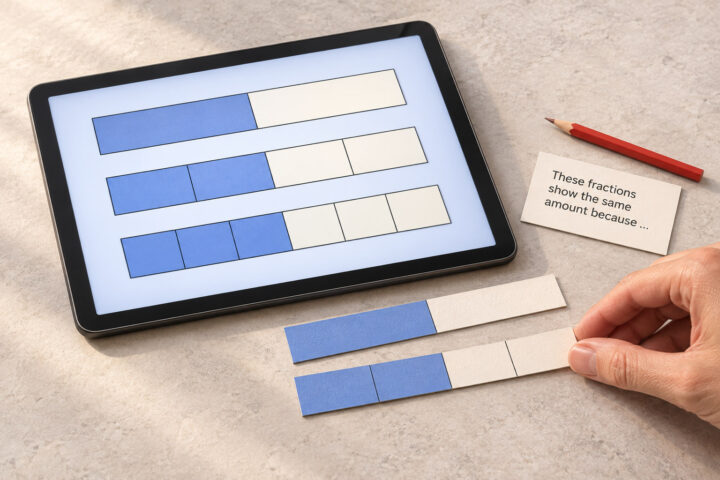
EdReports describes its mathematics review scope as year-long, comprehensive K–12 instructional materials. Its Math Review Tools provide one external reference point for reviewing core materials, rather than a reason to compare every resource that offers mathematics activities. Math Review Tools — EdReports
Request a comparable set of materials
Send the same request to each provider. Name the exact edition and the mathematical idea you want to examine. Ask for the following materials together, so you can connect the overview to the actual teaching.
Materials-request checklist
□ Program title, edition, publication version and format being offered.
□ Full scope and sequence, including prerequisites and later revisits of the chosen idea.
□ One complete sample unit—not just a showcase lesson—with its place in the year identified.
□ Teacher guidance for every lesson in that unit, including preparation, suggested prompts and worked examples where provided.
□ All pupil tasks, recording sheets and required representations or manipulatives.
□ Guided practice and independent practice, including answers and explanations.
□ Checks before, during and after the unit, with scoring or interpretation guidance.
□ Suggested responses to different pupil answers and any follow-up tasks.
□ Any parallel routines needed to understand the sequence, not just the main unit.
□ A list of required materials, access arrangements and components not included in the sample.
Mark unavailable materials as “not inspected”, not “absent from the program”. A component list establishes what a provider advertises; it does not show whether the tasks, explanations or follow-up guidance are usable for your particular teaching goal.
Use real program descriptions to target your requests
Illustrative Mathematics states that its complete IM Math curriculum is accessible online at no cost, including full lessons, printable PDFs and implementation resources. The IM K–5 Math v.360 page is therefore a starting point for obtaining materials to inspect. IM K–5 Math v.360 — Illustrative Mathematics
The Kendall Hunt Grade 1 scope and sequence for Illustrative Mathematics describes a section on adding within 100 with composing a ten. It includes connecting methods and representations, including equations, that show a new ten composed from ten ones. Grade 1 Scope and Sequence — Illustrative Mathematics, Kendall Hunt
Keep those two records separate: the Kendall Hunt sequence should not automatically be attributed to v.360. Request the scope and sequence belonging to the exact edition under consideration before recording an edition-specific strength.
The Math Learning Center identifies two core components of Bridges in Mathematics Third Edition: Bridges Units and Number Corner Months. Welcome, Prospective Bridges Educators! — The Math Learning Center
For Bridges, request the relevant unit and any Number Corner materials connected to the chosen idea. Ask where teaching, practice and assessment sit across the two components rather than judging the sequence from a unit sample alone.
Great Minds lists Lesson Pages, Problem Sets, the Talking Tool and the Thinking Tool in Eureka Math² K–5 pupil workbooks, with Exit Tickets except in Kindergarten. Its lesson-structure guidance describes four parts: Fluency, Launch, Learn and Land. Eureka Math² Program Components — Great Minds Lesson Structure — Eureka Math² Teacher Success Pathways
For Eureka Math², request the corresponding Teach and Learn pages, practice and assessment guidance for the same sequence. Record what happens within the four lesson parts; their names alone do not answer whether explanations, practice and assessment address the same mathematical goal.
Follow one idea through six review steps
1. Fix a narrow goal. For this comparison, use: “Add two one-digit numbers with a total greater than ten, and explain how partitioning one addend can make a ten.” Use the same goal for every candidate, even if its unit title is broader.
2. Trace the sequence backwards and forwards. Find where pupils encounter parts that make ten, where addition across ten is introduced and where the idea is revisited. Record the lesson references. Do not infer a sequence from the order of headings alone.
3. Read the explanation beside the representation. Locate a worked example, modelled solution or task discussion. Check whether the guidance connects the quantities, the movement or drawing, and the equation. Ask exactly where the remaining part of a split addend is accounted for.
4. Follow the practice. Separate teacher-supported work from work pupils complete independently. Note what changes between questions: numbers, representation, wording or demand for explanation. Inspect whether pupils only reproduce a displayed procedure or also explain, select or compare methods.
5. Match assessment to the goal. Find an item that checks the total and an opportunity to show how ten was made. Read the answer guidance. Ask what you would do next for a correct answer with an unclear explanation, an incomplete partition or an accurate counting strategy.
6. Test the teacher guidance. Use the pupil responses below as a desk review: can you locate a specific prompt, model or follow-up task for each response? Record the exact location, or make a follow-up request. For a separate planning model with task sheets and response-based decisions, use Formative and summative assessment: plan both for one maths goal.
The What Works Clearinghouse’s March 2021 guide recommends a well-chosen set of concrete and semi-concrete representations for mathematics intervention with elementary pupils struggling with mathematics. Assisting Students Struggling with Mathematics: Intervention in the Elementary Grades — WWC, March 2021
Use that intervention guidance to sharpen questions about representations, not to rank whole-class core programs. This review supports a materials-based shortlist, not an effectiveness league table; it does not establish current-edition head-to-head effectiveness.
Sequence A: making ten with a ten-frame
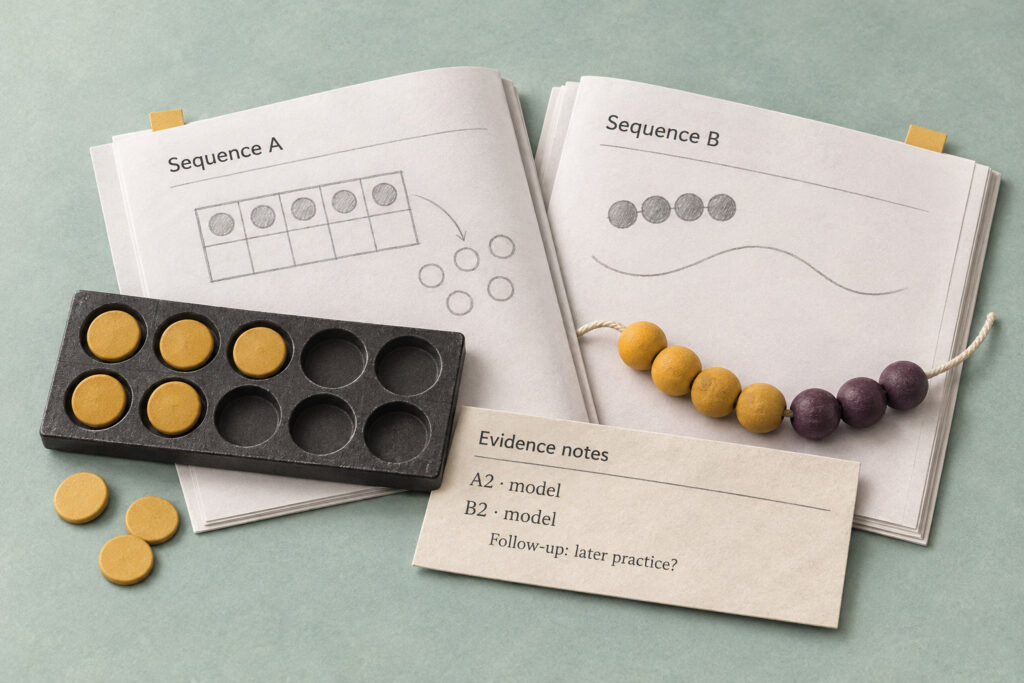
The classroom examples and pupil responses below are hypothetical. Sequence A begins with pairs that total ten. The teacher then places eight counters on a ten-frame and five beside it. Two of the five fill the frame; three remain outside. The explanation connects that action to 8 + 5 = 8 + 2 + 3 = 13, explicitly tracking all five counters.
Guided practice uses 9 + 4 with counters: “How many will complete ten? How many of the four remain?” Independent practice asks pupils to solve 8 + 6, draw or describe the partition, and explain where each part of six appears. A final check uses 7 + 5 and asks for both a total and an explanation of making ten.
Review record for Sequence A
Material inspected: sample lesson A2, modelled example and guided practice; A3, independent task and final check.
Precise observation: the model explicitly connects moving two counters with splitting five into two and three; the independent task requires an explanation rather than a total alone.
Documented strength: a visible connection between the partition, the ten-frame and the equation.
Follow-up question: what guidance follows a response of “8 + 6 = 10” after the pupil fills the frame but ignores the remaining counters?
Still to inspect: later practice without the frame and a subsequent revisit of the idea.
Sequence B: making ten with a bead string and number line
Sequence B starts with a bead string showing seven beads and a further six. The teacher marks a first move of three to reach ten, then moves the remaining three. A matching number-line drawing shows the same two jumps. The worked example is 7 + 6 = 7 + 3 + 3 = 13.
Guided practice asks pupils to compare counting on with making ten for 9 + 5. Independent work asks them to solve 6 + 8, annotate a drawing and explain the split they chose. The final check asks whether “6 + 8 = 6 + 4 + 4” is a useful rewrite, and why.
Review record for Sequence B
Material inspected: sample lesson B2, bead-string example and matching number line; B3, method comparison and final check.
Precise observation: the worked example uses two representations of the same split; the independent task permits pupils to choose and explain a partition.
Documented strength: the materials invite comparison of methods rather than requiring one displayed layout.
Follow-up question: does the teacher guidance explicitly connect the bead groups to the lengths of the jumps, or leave that connection for the teacher to supply?
Still to inspect: the response guidance for pupils who count accurately but cannot yet explain the make-ten rewrite.
Do not select A simply because it uses a ten-frame, or B because it includes a number line. Compare the clarity of the mathematical connections, the demands of independent work and the guidance available when a pupil responds differently from the model.
Copy-ready questions for testing the review criteria
1. Solve 8 + 6. Show how you could make ten.
2. Complete and explain: 7 + 5 = 7 + ___ + ___ = ___.
3. A pupil writes: “9 + 4 = 10 + 4 = 14.” What would you ask them to check?
4. Solve 6 + 8 in two ways. Explain why the totals agree.
Answer guide
1. 14. One make-ten explanation is to split six into two and four: 8 + 2 + 4 = 14.
2. 3, 2, 12 gives a make-ten partition: three completes ten and two remains. Other mathematically correct partitions need a follow-up question about making ten, not an automatic error mark.
3. Ask, “If one of the four was used to turn nine into ten, how many remain?” The corrected rewrite is 10 + 3 = 13.
4. For example, 6 + 4 + 4 = 14 and 8 + 2 + 4 = 14. Both retain all the quantities from the original addition, but start by completing a different addend to ten.
Check whether teacher guidance gives you a usable next step
Pupil response: “8 + 5 is 13. I counted on: 9, 10, 11, 12, 13.”
Possible next prompt: “That gives the correct total. Can you also show how some of the five could complete ten?”
Review question: does the guidance recognise accurate counting as valid while offering a specific way to explore the lesson’s make-ten goal?
Pupil response: “8 + 5 is 10,” with two counters moved into the frame and three left beside it.
Possible next prompt: “Point to all five counters you added. Which are in the frame, and which are still outside?” Then ask the pupil to recount the combined quantity and connect it to 10 + 3.
Review question: does the guidance address the unaccounted-for remainder, or merely repeat the original demonstration?
Pupil response: “8 + 5 = 13,” but no explanation is recorded.
Possible next prompt: “Show me how you found it. You may use counters, a drawing or an equation.”
Review question: does the assessment guidance distinguish a correct total from evidence of the targeted partition, without assuming that missing written work means missing understanding?
Pupil response: “I split eight into five and three, then did five plus five plus three.”
Possible next prompt: “Show which parts came from the eight. Where is ten in your calculation?”
Review question: does the guidance accommodate a correct alternative partition rather than treating a different starting point as an error?
If your review moves into tens-and-ones regrouping, Formative assessment examples: a whole-number place-value check offers response-based follow-up tasks and matching recheck questions. Use it to plan that separate check rather than treating an addition-across-ten answer as evidence about every aspect of place value.
Copy-ready comparison table
Copy the tab-separated comparison table below into a spreadsheet, or convert the text to a table using tabs as column separators. Replace the bracketed entries and add one row for each observation. Keep your interpretation separate from what is actually printed or displayed. Give page numbers, lesson identifiers or digital section names precisely enough for a colleague to find the same evidence.
| Program/edition | Mathematical goal | Material inspected | Precise observation | Evidence location | Follow-up question |
|---|---|---|---|---|---|
| [Name and exact version] | [Specific goal being checked] | [Unit, lesson and component] | [What the task or guidance actually contains] | [Page, item or digital section] | [What remains to be checked] |
| [Name and exact version] | [Same goal] | [Practice materials] | [What pupils do independently] | [Page, item or digital section] | [Question about practice] |
| [Name and exact version] | [Same goal] | [Assessment and teacher guidance] | [What is checked and what next step is offered] | [Page, item or digital section] | [Question about assessment or follow-up] |
Copy as tab-separated text
Program/edition	Mathematical goal	Material inspected	Precise observation	Evidence location	Follow-up question
[Name and exact version]	[Specific goal being checked]	[Unit, lesson and component]	[What the task or guidance actually contains]	[Page, item or digital section]	[What remains to be checked]
[Name and exact version]	[Same goal]	[Practice materials]	[What pupils do independently]	[Page, item or digital section]	[Question about practice]
[Name and exact version]	[Same goal]	[Assessment and teacher guidance]	[What is checked and what next step is offered]	[Page, item or digital section]	[Question about assessment or follow-up]
| Program/edition | Mathematical goal | Material inspected | Precise observation | Evidence location | Follow-up question |
|---|---|---|---|---|---|
| Sequence A, hypothetical sample | Explain making ten when adding across ten | Lesson A2, modelled example | Two of five counters complete a frame holding eight; three remain. The equation tracks both parts. | A2, modelled example | Where is this revisited without a ten-frame? |
| Sequence B, hypothetical sample | Explain making ten when adding across ten | Lesson B2, worked example | The bead string and number line show six split into three to reach ten and three remaining. | B2, worked example | Where does the guidance connect the bead groups to the jump lengths? |
Copy as tab-separated text
Program/edition	Mathematical goal	Material inspected	Precise observation	Evidence location	Follow-up question
Sequence A, hypothetical sample	Explain making ten when adding across ten	Lesson A2, modelled example	Two of five counters complete a frame holding eight; three remain. The equation tracks both parts.	A2, modelled example	Where is this revisited without a ten-frame?
Sequence B, hypothetical sample	Explain making ten when adding across ten	Lesson B2, worked example	The bead string and number line show six split into three to reach ten and three remaining.	B2, worked example	Where does the guidance connect the bead groups to the jump lengths?
Compare rows for the same goal side by side. First compare the observations and their locations; then compare the unanswered questions. Add a separate row for practice, assessment or response guidance rather than combining several judgements into one entry.
Build a shortlist with reasons, not unsupported rankings
Complete this record for each candidate. Avoid an overall numerical score unless your team has agreed what each score means and how missing information will be handled. A documented feature, an unanswered request and a classroom question should not be collapsed into one judgement.
Shortlist record
Program and exact edition:
Mathematical goal reviewed:
Materials inspected and date:
Documented strengths, each with an evidence location:
Missing information and person responsible for requesting it:
Matters requiring classroom investigation:
Practical requirements to confirm, including preparation, materials and access:
Decision: retain for closer review / await materials / do not progress for this use.
Reason for decision:
Next action, owner and review date:
For a candidate resembling Sequence A, a shortlist entry might read: “Retain for closer review. The inspected example connects the counter movement to both parts of the split addend. Request the subsequent practice and assessment response guidance. During classroom investigation, note whether pupils explain the remaining part without an additional teacher-created prompt.” This is a bounded reason to investigate, not a claim that the program is more effective.
Before agreeing the shortlist, ask a colleague to locate several recorded observations in the materials. Resolve differences by returning to the task or guidance itself. Finish with a clear record of what you know, what you still need and what you will examine in classroom use.