

Easy science experiments for kids at home can turn an everyday question into something children can test and observe. The most useful activities are not the ones with the biggest reaction. They are the ones that match the child’s abilities, use materials an adult has checked, and make one change easy to notice.
The American Chemical Society’s elementary science activities emphasize controls, changing one variable, observing, measuring, recording data, and drawing reasonable conclusions. Those habits matter more than getting a dramatic result.
Editorial disclosure: Educators Support uses an automated research, drafting, and verification workflow. This article provides general educational information and does not imply human or clinical review.
Choose an Experiment Safely
Start with the specific activity, the child, and the place where you will do it. An activity may be simple for one child and unsuitable for another because of allergies, mouthing, impulsivity, motor demands, sensory needs, or difficulty following a stop instruction. An adult should select the activity, read every product label, and remain present.
Home science safety checklist
- Use only the listed materials. Do not substitute cleaners, medicines, powders, fuels, or other products because they look similar. Never mix household cleaning products.
- Prepare before the child joins. Clear the work area, protect the surface, use stable plastic containers when practical, and keep unused products locked away.
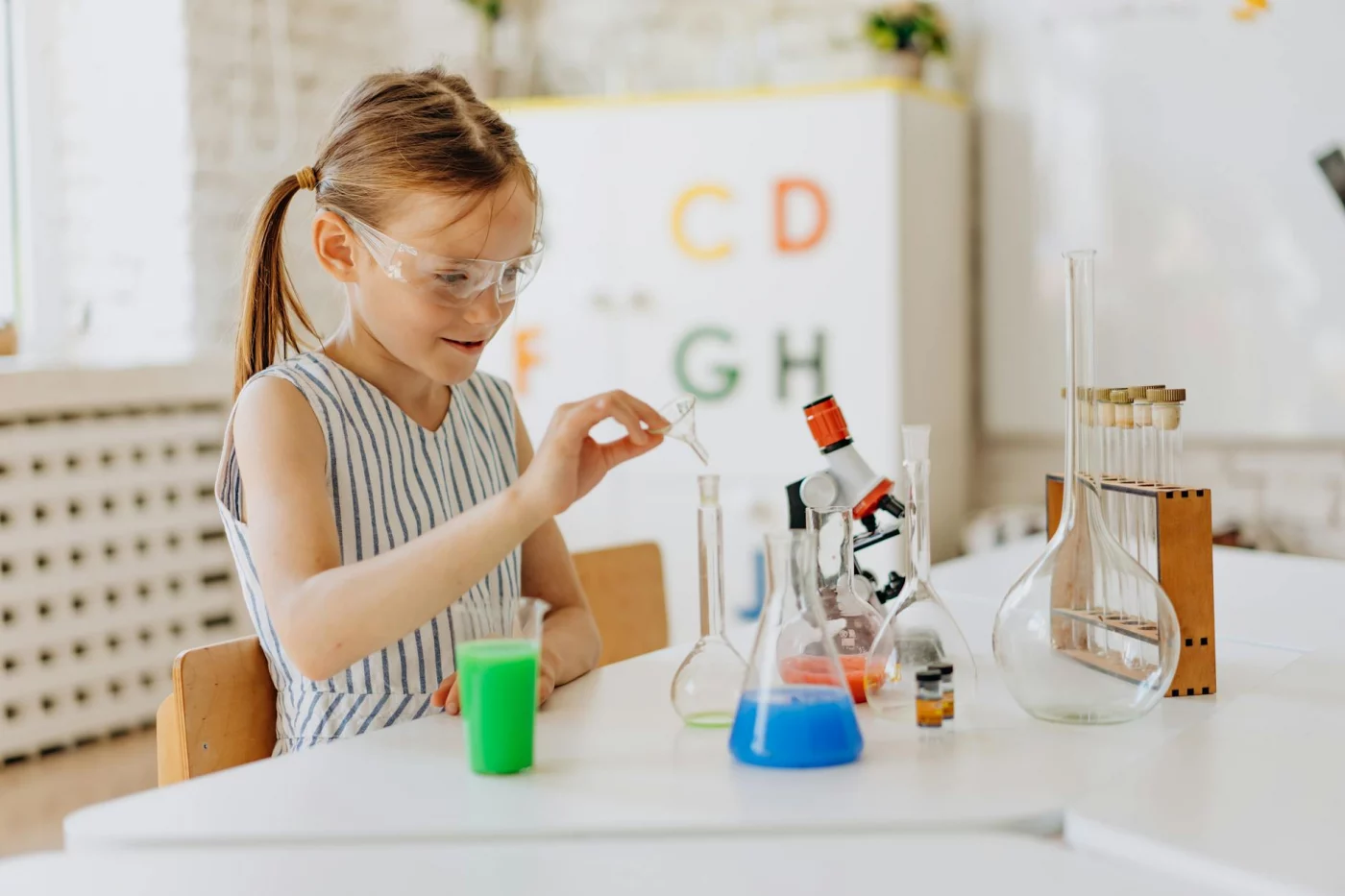
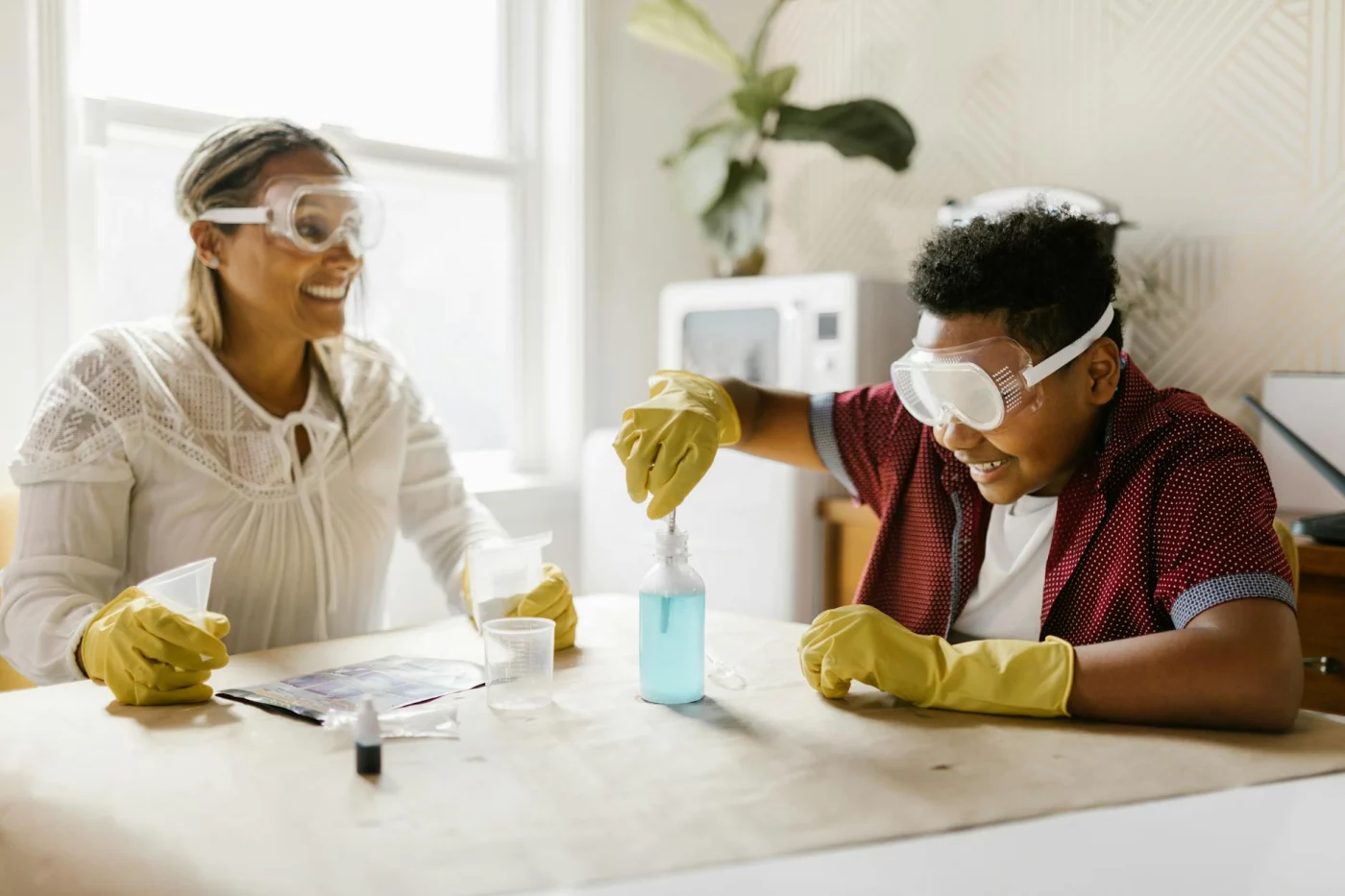
- Protect eyes and skin. For activities that can splash, use properly fitting chemical splash goggles. Follow labels, avoid contact with eyes, and wash hands after the activity.
- Do not taste experiment materials. Food ingredients used for a test are no longer food. Keep hands, swabs, liquids, balloons, and small items away from mouths.
- Keep reactions open to the air unless the checked instructions specifically use a balloon. Never seal a fizzing mixture in a rigid container.
- Stop when conditions change. Pause for broken containers, unexpected heat, strong odor, eye or skin irritation, or a spill beyond the prepared tray. Follow the product label and local emergency guidance.
ACS at-home chemistry instructions call for adult supervision, properly fitting safety goggles, no tasting, and handwashing. Its broader RAMP safety framework is a useful planning model: recognize hazards, assess risks, minimize risks, and prepare for emergencies. These ten activities deliberately exclude heat, flames, concentrated chemicals, strong oxidizers, and demonstrations that need laboratory controls.
Pick by question, time, and mess
Age labels are poor substitutes for judgment. Instead, ask whether the child can use the materials safely, follow the steps with support, and stay with the question long enough to observe a result. Times below are planning estimates, not promises; temperature, materials, and setup can change what happens.
- For a quick visible change: pepper and soap, magic milk, or static balloon.
- For sorting and prediction: sink or float.
- For a comparison: ice melt or sugar-water density layers.
- For a slower observation: walking water.
- For an adult-directed chemical reaction: the baking soda balloon.
Use a predict-test-observe cycle
- “What do you predict will happen, and why?”
- “What changed? What stayed the same?”
- “What is one thing we could change in the next test?”
For a fair comparison, change one factor and keep the others as similar as practical. Use the same container size, amount, waiting time, or starting temperature when that factor is not the question. A drawing, tally, photo taken by the adult, or one-sentence note can be the record.
10 Easy Science Experiments
The activities below retain the ten low-prep experiments from this guide. Each card separates what to gather, what to do, what to notice, and the activity-specific safety check. Exact results vary, which gives children something real to compare rather than a performance they have to reproduce.
Experiment comparison table
| Experiment | Question to investigate | Approximate time | Extra check |
|---|---|---|---|
| Magic milk | How does a drop of soap change the movement of color? | 5–10 minutes | Dairy sensitivity; no tasting |
| Baking soda balloon | What evidence shows that a gas formed? | 10 minutes | Adult-directed; goggles; balloon warning |
| Tornado in a bottle | How does spinning speed change the vortex? | 5 minutes | Plastic bottle; cap checked by adult |
| Sugar-water layers | How does dissolved sugar affect layering? | 15–20 minutes | No tasting |
| Oil-and-water fizz bottle | What moves through the oil, and what stays separate? | 10 minutes | Adult handles tablet; never cap |
| Walking water | How does water move through a paper towel? | 20–60 minutes | Stable cups; protect surface |
| Sink or float | Which properties help predict the result? | 10 minutes | No mouthable or unsafe objects |
| Static balloon | What changes after the balloon is rubbed? | 5 minutes | Adult controls balloon |
| Pepper and soap | How does soap change the water’s surface? | 5 minutes | Not a handwashing demonstration |
| Ice melt comparison | How does salt change melting? | 10–20 minutes | Wash hands; avoid eyes |
Materials, steps, explanations, and safety
1. Magic milk
Gather: a shallow tray, milk, food coloring, liquid dish soap, and a cotton swab. Test: pour a thin layer of milk into the tray, add separated drops of color, then touch the surface once with a swab dipped in soap. Notice: where movement begins, how far color travels, and whether a second touch produces the same pattern.
Explanation: The ACS magic-milk activity explains that detergent molecules spread across and interact with water, protein, and fat molecules in milk; the moving liquid carries the food coloring. Different milk compositions can produce different patterns, so a comparison should use the same dish and amount. Safety: do not drink the mixture; check dairy and product sensitivities; wear properly fitting goggles and wash hands.
2. Baking soda balloon
Gather: an empty small plastic bottle, vinegar, baking soda, a funnel, and a balloon. Test: an adult places a measured amount of vinegar in the bottle and baking soda in the balloon, secures the balloon over the bottle, then lifts it so the powder falls into the vinegar. Keep the bottle standing on a tray and observe without squeezing it.
Explanation: The reaction forms carbon dioxide gas, which takes up space and inflates the balloon. The ACS baking soda and vinegar investigation uses equal quantities to support fair comparisons and notes that vinegar can irritate skin and eyes. Safety: this is adult-directed; wear properly fitting splash goggles, keep the balloon away from mouths, check for latex concerns, wash hands, and discard broken pieces immediately.
3. Tornado in a bottle
Gather: a clear plastic bottle with its original cap, water, and one small drop of dish soap. Test: an adult fills the bottle about two-thirds, adds the soap, closes the cap firmly, and checks for leaks. Swirl the bottle in a circle, set it down, and watch the funnel-shaped motion. Compare a gentle swirl with a faster one.
Explanation: Rotating water forms a vortex. Water moves faster around the outside and downward near the center as air moves through the middle. Safety: use plastic, not glass; the adult checks the cap before each trial; do not open or drink the mixture.
4. Sugar-water density layers
Gather: four small clear cups, water, sugar, food coloring, measuring spoons, and a dropper. Test: an adult prepares equal amounts of water with increasing measured amounts of sugar, using a different color for each. Add the most concentrated solution first, then slowly add the others down the side with a dropper.
Explanation: Dissolving more sugar in the same volume of water increases the solution’s density. Slow pouring reduces mixing, so layers may remain visible for a while. Safety: the liquids are for observation, not drinking; clean spills promptly because sugar water makes surfaces sticky and slippery.
5. Oil-and-water fizz bottle
Gather: a clear plastic bottle or tall cup, water, vegetable oil, food coloring, and an effervescent tablet whose label an adult has checked. Test: add water, then oil, leaving generous space at the top. Add food coloring and let an adult drop in a small tablet piece. Keep the container open while observing.
Explanation: Oil and water remain in separate layers. Gas bubbles from the dissolving tablet carry small amounts of colored water upward; when the gas escapes, the water falls. Safety: an adult handles and stores the tablet; do not taste any material; never cap or seal the container during or after fizzing; skip this activity if the product label or child’s needs make it unsuitable.
6. Walking water
Gather: three stable clear cups, water, two food-coloring colors, and two folded paper-towel strips. Test: fill the two outer cups with equal amounts of differently colored water and leave the middle cup empty. Bridge each outer cup to the middle with a towel strip. Mark the starting water levels and check them at regular intervals.
Explanation: Water adheres to and travels through tiny spaces among the paper fibers by capillary action. Gravity and changing water levels affect the movement. Safety: place cups on a protected surface where they cannot be pulled over; do not drink the colored water.
7. Sink or float
Gather: a wide plastic bowl of water and a small set of adult-selected, washable objects that are not sharp, electrical, absorbent, valuable, or a choking risk for anyone present. Test: name each object, predict sink or float, test it, and sort the result. Then compare two objects made from the same material but shaped differently.
Explanation: Floating depends on the object’s average density, shape, and how much water it displaces. Size alone does not determine the result. Safety: an adult selects every object and stays within reach; empty the bowl immediately after the activity.
8. Static balloon
Gather: one fully inflated balloon controlled by an adult and large, easy-to-collect paper shapes. Test: rub the balloon on dry fabric, bring it near the paper without touching, and compare the movement before and after rubbing. Try changing only the number of rubs.
Explanation: Rubbing transfers electric charge. The charged balloon can attract lightweight neutral paper because charges within the paper shift slightly. Humidity may weaken the effect. Safety: follow the balloon warning above; do not use tiny paper pieces around children who mouth objects; stop and discard every piece if the balloon breaks.
9. Pepper and soap
Gather: a shallow dish, water, ground pepper, liquid dish soap, and a cotton swab. Test: sprinkle a light, even layer of pepper on the water. Touch the surface once with a clean swab, then repeat with a soapy swab and compare what moves.
Explanation: The soap lowers surface tension where it touches. Water pulls more strongly in other directions and carries the floating pepper away from that point. Safety: do not present this as proof that pepper represents germs or that soap makes germs “run away”; prevent eye contact and wash hands after the activity.
10. Ice melt comparison
Gather: two equal ice cubes, two identical shallow dishes, salt, a measuring spoon, and a timer. Test: place one cube in each dish, add a measured amount of salt to one, leave the other untreated, and observe at equal time intervals. Record puddle size or the approximate remaining cube size.
Explanation: Salt lowers water’s freezing point; the ACS lesson on freezing explains why an ice-and-salt mixture can fall below water’s normal freezing point. Keep cube size, dish, location, and timing similar for a useful comparison. Safety: do not eat experiment ice; avoid touching eyes; wipe up water and wash hands.
Questions That Extend the Learning
A strong extension changes one factor rather than adding more ingredients. Use the original safety check again before any new trial.
- Magic milk: What changes when the milk type changes but the dish, amounts, and soap stay the same?
- Walking water: Does towel width change the time needed for water to reach the middle cup?
- Sink or float: Can reshaping the same material change the result?
- Ice melt: How does a measured smaller amount of salt compare with a larger amount?
- Static balloon: Does humidity or fabric type change the paper’s movement?
Ask the child to distinguish observation from explanation. “The balloon became larger” is an observation. “A gas formed and filled it” is an explanation supported by the setup and the ACS reaction guidance. That distinction helps children reason from evidence without requiring technical vocabulary first.
Common Questions
Which experiment should beginners try first?
Choose the activity with the fewest hazards and the clearest visible result for the child and setting. Sink or float can work well when an adult selects safe objects. Pepper and soap or walking water can also be simple choices when product sensitivities and spills are manageable.
How can an activity become a fair test?
Ask one comparison question, change one factor, and keep the other important conditions as similar as practical. Measure amounts when possible, use the same containers, observe for the same length of time, and record the result. The ACS science-activity framework uses the same core practices: controls, variables, observation, measurement, records, and conclusions.
Can these experiments be used in a classroom?
A teacher must follow school or district policy, complete the appropriate risk assessment, use required protective equipment, plan for allergies and accessibility, and supervise the room. A home activity is not automatically a classroom-ready laboratory procedure. Use an institution-approved source and safety process before adapting any activity for a group.
What if the result looks different from the description?
Record what actually happened. Differences in temperature, material amounts, milk composition, humidity, container shape, and timing can change an observation. Check the procedure and safety conditions, then repeat only if the adult decides it is safe. An unexpected result is information, not a failure.
Choose One and Test One Idea
Pick one activity that fits the child, materials, and setting. Prepare the safety controls first, ask for a prediction, run the test, and record one observation. A short, careful investigation is more valuable than a complicated demonstration with unclear risks or no question.
For more low-prep learning support, visit the Learning & Activities hub, explore creative home learning strategies, or review the site’s DIY activity safety guide.


