

If you’re looking for classroom management strategies that elementary teachers can use when students are noisy, off-task, wiggly, or distracted, you probably do not need another generic list. You need calm, low-disruption moves that help children refocus without turning the whole day into correction mode.
Saying “focus, please” for the twelfth time before 10 a.m. drains everyone. If one student is tapping, another is wandering, and three are suddenly fascinated by pencil shavings, the question becomes: how do I bring them back without yelling, shaming, or handing out rewards every five minutes?
Editorial disclosure: Educators Support uses an automated research, drafting, and verification workflow. This article provides general educational information and does not imply human or clinical review.
Contents
- Elementary Classroom Management — Less Correction, More Learning
- Before Day One: Make Expectations Teachable
- Build Focus Before Problems Start
- Redirect Without Yelling
- What to Avoid
- Evidence-to-Practice Classroom Matrix
- Make It Usable Tomorrow
- Frequently Asked Questions
- Small Systems That Protect Focus and Dignity
Elementary Classroom Management — Less Correction, More Learning
The strongest management systems reduce how much correcting has to happen out loud. Less public correction usually means less noise, less embarrassment, fewer delays, and a teacher who still has energy after morning lessons.
Why correction can backfire
Calling a name across the room, repeating directions louder, debating with a student, or stopping instruction again and again can pull everyone’s attention away from the work. Some children get more dysregulated when corrected publicly; others simply lose the thread of the lesson.
Many elementary students are still building executive function skills like working memory, impulse control, and task initiation. The Harvard Center on the Developing Child explains executive function as a set of skills that develops over time. Instead of “Jayden, stop talking,” try pausing near the desk and pointing to step one on the board.
What low-disruption management looks like
Low-disruption management means preventing confusion, cueing quietly, protecting dignity, and returning students to the task fast. It often includes:
- clear routines and visible directions before the task begins;
- a gesture, card, or silent cue before a spoken correction;
- teacher proximity before a public reminder;
- a short private prompt instead of a lecture;
- a reset choice when a student is stuck;
- support from the right school team when behavior is unsafe or persistent.
The goal is not a perfect room; it is a predictable one students can practice. Keep public interruptions as brief as possible and move attention back to learning.
Scope and support note
This guide provides general educational information. It does not diagnose a student or replace school policy, an authorized support plan, or guidance from qualified education, health, or mental-health professionals.
Follow the school’s support process when behavior is unsafe, persistent, escalating, trauma-related, or possibly disability-related. For foundational planning, use the before-day-one classroom plan below.
Before Day One: Make Expectations Teachable
A plan is easier to use when it separates broad expectations from the steps students must perform. The What Works Clearinghouse Teacher-Delivered Behavioral Interventions in Grades K–5 practice guide supports explicitly teaching and modeling expected behavior, reminding students, acknowledging expected behavior, offering instructional choices, and helping students reflect on behavior.
If you want the core terms before building a plan, start with a simple definition of classroom management and then return to the routines below.
Rules, routines, procedures, consequences, and supports
| Term | What it means | Example |
|---|---|---|
| Rule or expectation | A broad standard students can see and practice. | Use words and actions that keep people safe. |
| Routine | A repeated pattern for a familiar part of the day. | Enter, put away belongings, check the board, and begin the posted task. |
| Procedure | The specific steps for completing a classroom task. | Use the help signal, continue with the next item, and wait for the teacher to check in. |
| Consequence or response | What follows a behavior under the school’s policy and classroom plan. | Pause, reteach the procedure, repair any harm, and return to learning when ready. |
| Additional support | Team-planned help when universal routines are not enough. | Follow an existing support plan and coordinate with the appropriate school team and family. |
Set up the room and the plan
- Choose a short set of observable expectations that aligns with schoolwide expectations.
- Map the routines most likely to interrupt learning: arrival, materials, help-seeking, transitions, group work, device use, cleanup, and dismissal.
- Post a readable schedule, task steps, and one attention signal students can practice.
- Reduce traffic bottlenecks and make frequently used materials easy to reach and return.
- Decide how minor corrections will differ from behavior that requires an immediate school-policy or safety response.
- In U.S. settings, review IEPs and Section 504 plans; in every setting, follow the student’s authorized support plan and relevant school procedures with the appropriate team before changing supports.
A first-week teaching sequence
| Day | Priority |
|---|---|
| Day 1 | Teach entry, the first task, the attention signal, one transition, and dismissal. |
| Day 2 | Practice materials, movement, help-seeking, and any essential bathroom procedure. |
| Day 3 | Teach partner talk, independent-work expectations, and what to do after finishing. |
| Day 4 | Practice small-group or center transitions, device routines, and cleanup. |
| Day 5 | Review the routines that caused confusion, practice them again, and keep the parts that worked. |
A first-month review cycle
- Week 1: teach and model the highest-use routines.
- Week 2: tighten transitions with visible steps, brief reminders, and more practice.
- Week 3: review patterns by time, task, setting, and transition; communicate with families or the school team when appropriate.
- Week 4: reteach weak routines, simplify systems that are hard to maintain, and request team support for persistent concerns.
This sequence is a planning example, not a required calendar. Slow down, repeat a routine, or follow an individual plan whenever students need a different pace or support.
Build Focus Before Problems Start
Less correction starts before the lesson begins. A visible setup with clear expectations, posted steps, and a consistent attention signal prevents many behavior issues before they grow.

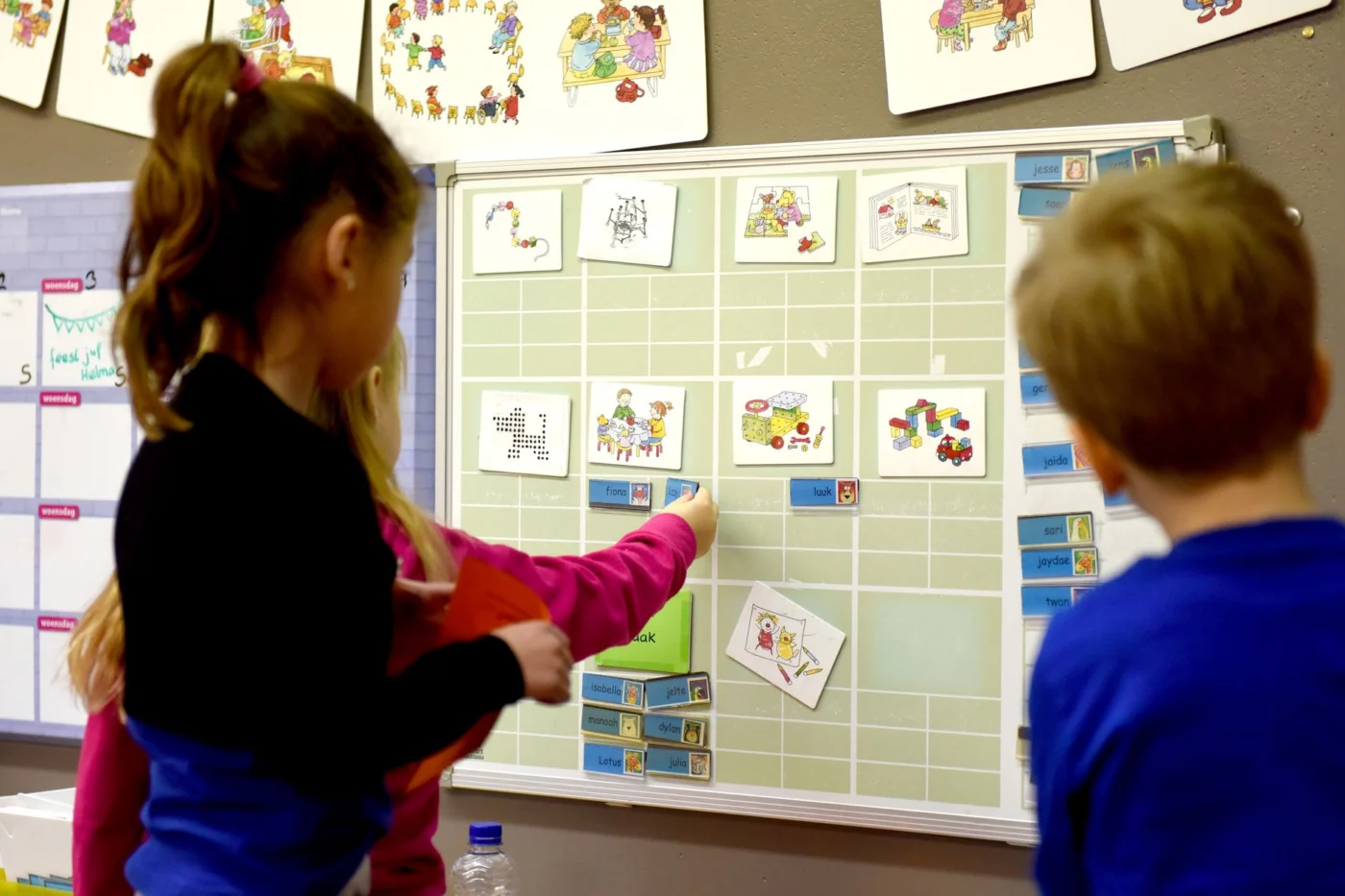
Use concrete phrases such as “Use a learning voice,” “Start with step one,” and “Keep materials in your space.” Visuals, quick modeling, and short directions reduce the working-memory load for students who are still learning how to manage time, materials, and impulses.
A quick lesson setup
- Step 1: Name the task: “You’re solving the first six problems.”
- Step 2: Post 2 to 4 visual directions with words, icons, or quick sketches.
- Step 3: Briefly model step one.
- Step 4: Ask, “Show me with your finger where you’ll begin.”
- Step 5: Circulate early and quietly prompt stuck students before off-task behavior spreads.
Use first-then language
First-then language works best when both parts are calm, realistic, and immediate. Try: “First finish numbers 1 and 2, then bring it to me,” or “First check the board, then start with step one.” This is not bribing; it shows sequence and lowers uncertainty.
Practice routines when calm
Practice line-up, carpet, materials, device, and partner-talk routines outside stressful moments. Script it simply: “We’re going to practice this once so our brains know what to do later.” For substitutes and aides, keep one attention signal, one voice-level cue, and one posted task list. The simpler the system, the more likely adults and students will use it consistently.
Redirect Without Yelling
Once focus supports are in place, redirection gets quieter. Effective elementary behavior strategies protect dignity first, then bring the child back to the task.
Use a Least-to-Most Response Flow
Begin with the least disruptive prompt that is likely to help, then add support only when needed. The What Works Clearinghouse K–5 practice guide includes clear expectations, reminders, positive acknowledgment, and instructional choice among its classroom recommendations.
- Pause and point. Use the posted direction, model, schedule, or agreed nonverbal cue.
- Move closer. Use calm proximity without stopping instruction or creating a peer audience.
- Give a brief private reminder. Name the next observable action: “Open the notebook and start with step one.”
- Reteach the routine. If the expectation was unclear or has not been practiced, model the step and let the student try again.
- Offer a small instructional choice. Keep the task boundary clear while offering two workable ways to begin, such as desk or back table.
- Use the planned response. Follow school policy and any individual plan, protect dignity, repair harm where appropriate, and return attention to learning.
- Document a recurring pattern. Record observable context and involve the appropriate school team or family rather than guessing at a diagnosis or motive.
Skip directly to the school’s safety procedure when behavior is unsafe. This flow does not replace crisis procedures, an authorized student-support plan, or guidance from qualified school professionals. In U.S. settings, that may include an IEP or Section 504 plan.
Use private teacher language
Privacy lowers shame and removes the peer audience, which helps you avoid a public power struggle. This lines up with relationship-based guidance in our social emotional learning guide and with what the CDC shares about classroom supports for ADHD.
Try: “I am going to help you reset privately,” “Your next step is number two,” or “Let’s restart from here.” Fewer words help, especially for anxious students or children who often receive negative attention.
Offer two acceptable choices
Structured choice keeps the boundary clear: “You can begin at your desk or the back table.” Other options: pencil or marker, odd or even problems, read alone or with a partner. Keep choices small and immediate.
If a child refuses, say, “You don’t have to choose yet. I’ll give you one quiet minute, then I’ll come back and help you pick.” For trauma-sensitive practice, Harvard’s Center on the Developing Child is a helpful starting point.
What to Avoid
Even kind teachers can accidentally escalate things when the room is loud and time is short. These traps are common, but they are fixable.
Public correction loops
Public correction loops are predictable: correction, embarrassment, defensiveness, repeat, peers watching, instruction stalled. Move close, point, prompt privately, then notice the return to learning: “Thanks for getting back to step one.”
Rewards that become the lesson
Rewards can help, but constant prizes can crowd out skill-building. Specific feedback often teaches more than a token:
- “You checked the board before asking me.”
- “You restarted after getting stuck.”
- “Your group lowered voices when I signaled.”
This keeps attention on the replacement behavior, not only on earning something.
Consequences that remove support
Be careful about removing recess, movement, breaks, or sensory tools from students who need regulation, unless safety or policy requires it. For ADHD-related concerns, coordinate with families and specialists; this ADHD support at school guide goes deeper.
When a student’s behavior is frequent, sudden, unsafe, or far outside their usual pattern, treat it as information. It may reflect attention needs, stress, grief, learning gaps, sleep changes, health concerns, or something else that requires team support.
Evidence-to-Practice Classroom Matrix
The 2024 IES What Works Clearinghouse guide for teacher-delivered behavioral interventions in grades K-5 recommends co-establishing and teaching clear expectations, using reminders, acknowledging expected behavior, offering instructional choices, and providing frequent opportunities to respond. Use the matrix below to turn those principles into observable routines rather than a generic reward system.
| When | Teacher action | Student action to teach | Check after one week |
|---|---|---|---|
| Lesson start | Show the goal, materials, first step, and finish signal. | Get the named material and begin the visible first step. | How many students start without a second whole-class direction? |
| Before a transition | Give a brief precorrection and point to the visual sequence. | Repeat or demonstrate the transition steps. | Which step still causes waiting, noise, or confusion? |
| During instruction | Use response cards, partner turns, choral response, or quick checks. | Respond often enough to stay cognitively active. | Who had few real opportunities to respond? |
| Early off-task behavior | Use proximity, a gesture, a visual, or a short private prompt. | Return to the next visible action without a public exchange. | Which low-disruption prompt worked with the least interruption? |
| Independent work | Offer two acceptable task or sequence choices when appropriate. | Choose, state the choice, and begin within the agreed time. | Did choice increase work initiation or only delay it? |
| Lesson close | Name a specific class action and preview the next use of the routine. | Reflect briefly on what helped focus. | Is the feedback describing behavior rather than labeling children? |
Collect a small amount of usable information rather than tracking everything: the routine, the context, what happened just before it, the support used, and whether engagement improved. If a pattern persists, involve the student, family, and school support team instead of escalating a universal consequence.
Make It Usable Tomorrow
After “what to avoid,” the next question is simple: what can you actually do tomorrow without yelling, bribing, or losing recess?
Adapt the System to Age and Context
The linked What Works Clearinghouse practice guide applies to grades K–5. The examples for older students and substitute settings below are contextual planning prompts, not claims that the guide evaluated those settings.
| Context | Useful emphasis | Example |
|---|---|---|
| Kindergarten–grade 2 | Short directions, pictures or modeling, repeated practice, and one transition at a time. | Point to the two pictured steps, model the first one, and practice the transition again. |
| Grades 3–5 | Visible checklists, private reminders, instructional choice, and taught self-monitoring. | Ask the student to check the posted steps, choose where to begin, and mark the completed step. |
| Older learners | Concise directions, private correction, meaningful choice, predictable follow-through, and local secondary-school guidance. | Offer two participation formats while keeping the same learning goal and deadline. |
| Substitute or shared classroom | The established teacher plan, a visible agenda, one attention signal, and clear notes for the regular teacher. | State the agenda and signal at the start instead of introducing a new reward or consequence system for one day. |
| Student with an individual plan | The documented accommodations, communication method, supports, and response procedures already authorized by the school team. | Use the agreed visual, break, seating, prompting, or communication support rather than improvising a replacement. |
Adapt the cue, amount of modeling, practice, and choice while keeping expectations understandable and instruction accessible. When behavior is persistent, escalating, unsafe, or substantially different from the student’s usual pattern, use the school’s support process.
Printable focus checklist
📋 Quick Reference
- Set up: Write the task, post steps, prep materials, choose an attention signal, plan one movement break.
- Redirect: Pause, signal, move closer, point to a visual, whisper a prompt, offer a structured choice.
- Reflect: What confused students? Which transition got loud? Who needed support before correction?
Save or print this as a simple focus checklist. The best classroom tools are often visible, repeatable, and easy to explain to another adult.
When to bring in support
Bring in support when behavior is unsafe, frequent, escalating, trauma-linked, or paired with sudden sleep, eating, mood, health, learning, or attendance changes. The CDC’s children’s mental health resources are a useful background source, but school teams and healthcare professionals should guide individual concerns.
Try a family conversation that starts with observation instead of blame: “I’m noticing reading transitions are hard after lunch. What helps at home?” For stress or grief concerns, see our emotional wellness resources.
Frequently Asked Questions
How can teachers improve focus without raising their voice?
Reduce how much students have to remember at once: post the task, point to the next step, and check privately for understanding. Use a consistent attention signal, give directions in short chunks, and redirect quietly before off-task behavior spreads. Visible directions and calm repetition usually work better than a louder teacher voice.
What are the five classroom management techniques teachers can use right away?
Try clear expectations, visual directions, practiced transitions, private redirection, and structured choice. Each works best when you teach it before the room is loud or students are already dysregulated. Even a 60-second rehearsal of lining up or turning in work can help.
How do you help ADHD students focus in class?
Common supports include visual directions, shorter work chunks, movement breaks, flexible seating options, and private prompts instead of public correction. Teachers should not diagnose ADHD or create medical treatment plans, but they can document patterns, share observations with families, and work with school support teams.
Small Systems That Protect Focus and Dignity
The most useful elementary classroom management approaches are often the simplest: teach focus before you demand it, give clear routines, redirect quietly, and avoid turning every off-task moment into a public correction. A calm signal, a practiced transition, a short choice, or a quick proximity check can save you from repeating directions all day.
If your classroom still feels loud, wiggly, or unpredictable, you are not doing it wrong. Children are learning how to be students while you are teaching the lesson, managing emotions, and watching the clock. Pick one strategy this week, try it for a few days, then adjust. Progress usually looks like fewer battles, not perfect silence.
For more practical support, explore our Education resources on EducatorsSupport.com. Start small, stay steady, and build the classroom rhythm your students can actually follow.


